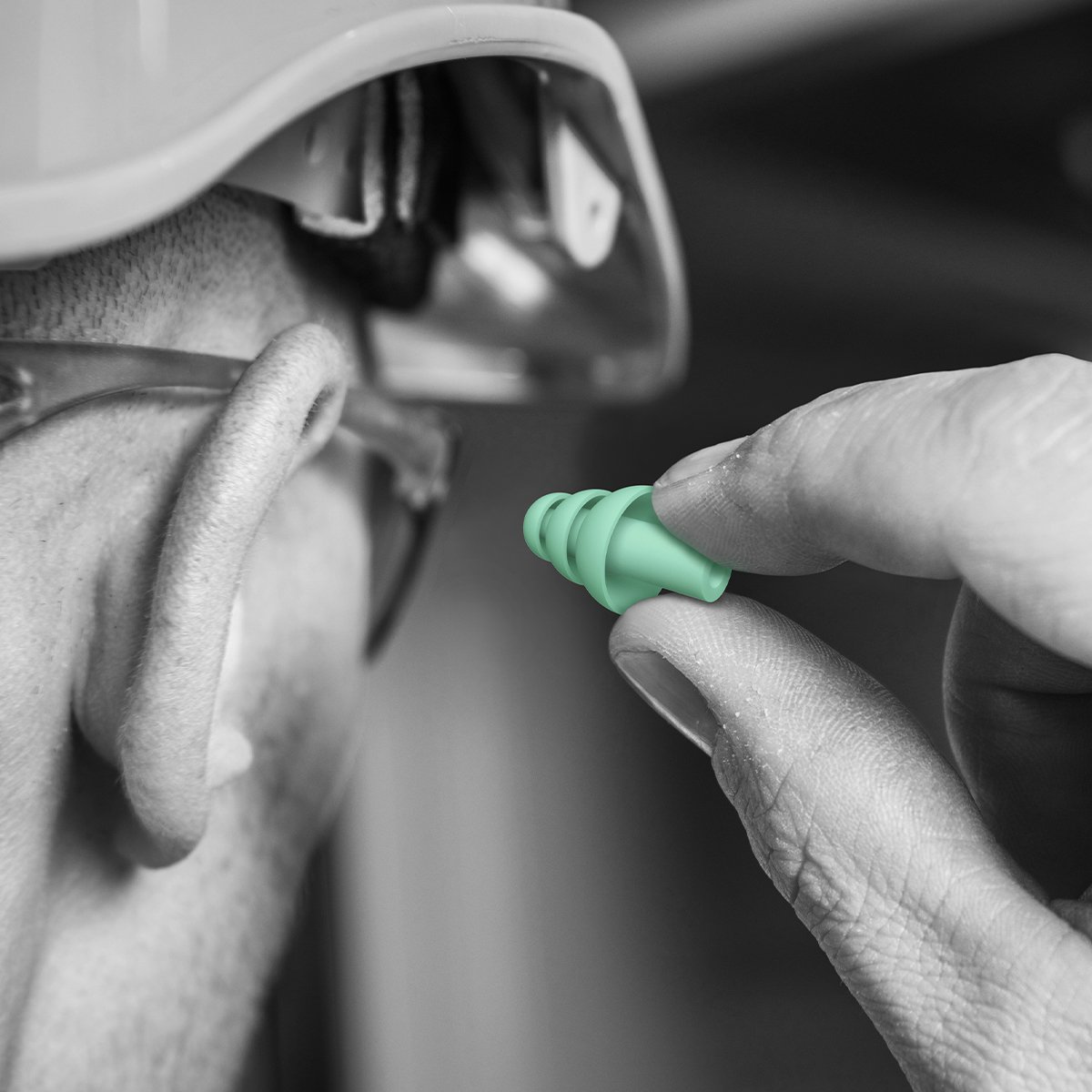
Power tools are loud enough to cause permanent hearing damage, and many common tools exceed 90 decibels, the threshold at which prolonged exposure starts to harm your hearing. A circular saw, for example, can hit 110 dB or more, which means even a few minutes of unprotected use puts your hearing at risk. The exact danger depends on how loud the tool is and how long you use it. Below, we cover the most important questions about power tool noise and what you can do to protect yourself.
What decibel level is considered dangerous for hearing?
Noise becomes dangerous for hearing at around 85 decibels (dB) with prolonged exposure. At this level, the hair cells inside your inner ear begin to experience stress, and repeated exposure without protection leads to cumulative hearing loss over time. The louder the sound, the faster the damage occurs.
The relationship between volume and damage is not linear. Every 3 dB increase doubles the sound intensity, which means the safe exposure time gets cut in half. At 85 dB, occupational health guidelines suggest a maximum of 8 hours per day. At 88 dB, that drops to 4 hours. At 100 dB, you are looking at under 15 minutes before the risk of damage becomes significant. Sounds above 120 dB, like a gunshot or a jet engine at close range, can cause instant and permanent damage.
For context, normal conversation sits around 60 dB. A busy restaurant might reach 80 dB. Most power tools operate well above both of those levels.
How loud are common power tools in decibels?
Most common power tools produce noise in the range of 85 to 115 dB, which places them firmly in the zone where hearing protection is necessary. The actual level depends on the specific tool, the material being worked on, and whether the tool is under load.
Here are approximate decibel levels for widely used power tools:
- Circular saw: 100 to 115 dB
- Angle grinder: 100 to 110 dB
- Reciprocating saw: 103 to 110 dB
- Jigsaw: 95 to 105 dB
- Drill: 85 to 95 dB
- Random orbital sander: 90 to 100 dB
- Router: 95 to 110 dB
- Nail gun: 100 to 110 dB
- Hammer drill: 100 to 115 dB
These figures are general estimates. Cutting dense hardwood with a circular saw, for example, produces more noise than cutting softwood. Using a tool on a hard surface that reflects sound back at you also increases your effective exposure level.
Which power tools are the loudest and most damaging?
The loudest and most damaging power tools are those that combine high decibel output with sustained use. Circular saws, angle grinders, hammer drills, and routers consistently rank among the most hazardous because they regularly exceed 100 dB and are often used for extended periods.
Impact tools like nail guns and jackhammers deserve special mention. While a nail gun fires in short bursts, each shot can peak above 110 dB, and the cumulative effect across a full workday adds up quickly. A jackhammer used in demolition or construction can reach 120 dB, putting it in the range of immediate risk territory.
Angle grinders are particularly worth watching. They are among the most common tools in workshops and on construction sites, and they are frequently used for long stretches without breaks. At 100 to 110 dB, even 30 minutes of unprotected use can start to stress your hearing.
How long can you use power tools before risking hearing damage?
At 100 dB, you can safely use power tools for roughly 15 minutes before the risk of hearing damage becomes significant. At 110 dB, that window shrinks to under 2 minutes. The louder the tool, the less time you have before your hearing is at risk, even if you feel no pain or discomfort in the moment.
This is one of the most misunderstood aspects of noise-induced hearing loss. It does not hurt while it is happening. Your ears do not send a clear warning signal the way your eyes do in bright light. The damage accumulates silently, often over years, until the effects become noticeable. By the time you notice ringing, muffled hearing, or difficulty understanding speech, the damage is already done.
If you use power tools regularly, even for relatively short sessions, the repeated exposure adds up. A weekend DIYer who spends two hours every Saturday using a sander and a circular saw without protection is accumulating meaningful hearing risk over the course of months and years.
What are the signs that power tool noise has damaged your hearing?
The most common signs of noise-induced hearing damage from power tools include ringing or buzzing in the ears (tinnitus), difficulty understanding speech in noisy environments, sounds seeming muffled after a session with tools, and needing to turn up the volume on devices more than usual.
Tinnitus, the persistent ringing or high-pitched tone in your ears after loud noise exposure, is often the first warning sign. If you notice ringing after a day in the workshop, your ears are telling you the noise levels were too high. Occasional temporary tinnitus can resolve on its own, but repeated episodes indicate that damage is building.
Other signs to watch for include:
- Struggling to follow conversations in social settings
- Asking people to repeat themselves more often than before
- Finding it hard to hear high-pitched sounds like birdsong or certain consonants in speech
- A feeling of fullness or pressure in the ears after tool use
Noise-induced hearing loss is permanent. Unlike some forms of hearing damage, it cannot be reversed with medication or surgery. This makes prevention the only real strategy.
What hearing protection should you wear when using power tools?
When using power tools, you should wear hearing protection rated to reduce your noise exposure to below 85 dB. For most common power tools operating between 95 and 110 dB, earplugs or earmuffs with an adequate noise reduction rating provide the protection you need.
Earmuffs are effective and easy to put on and take off, which makes them a practical choice for shorter tasks. Earplugs offer a more compact option and work well for longer sessions where you need to move around freely. For the best protection, the fit matters as much as the rating. An earplug that does not sit properly in your ear canal delivers far less protection than its stated rating suggests.
For professionals in manufacturing, construction, or any trade involving heavy tools and machinery, high-performance earplugs designed specifically for occupational use are the right choice. Shush Worker earplugs are built for exactly this purpose, with an SNR of 23 dB that reduces hazardous industrial noise to safe levels while keeping sound clear enough that you can still hear your surroundings and communicate with colleagues. They are made from durable, hypoallergenic synthetic rubber that lasts at least 365 days of regular use, and they are independently certified to EU, US, Canadian, and Australian/New Zealand standards. Unlike foam or standard silicone earplugs, the ceramic filter inside each earplug preserves sound quality rather than just muffling everything, which makes them far more comfortable to wear for a full workday.
Can you reduce power tool noise without hearing protection?
You can take steps to reduce the overall noise in your workspace, but these measures alone are not a substitute for wearing hearing protection when using loud power tools. Noise control strategies lower your total exposure, but most power tools will still produce levels that exceed safe thresholds without ear protection in place.
That said, practical noise reduction steps are worth combining with hearing protection:
- Maintain your tools: Dull blades and worn components make tools work harder and louder. Sharp, well-maintained tools run more quietly.
- Work on dampened surfaces: Hard, reflective surfaces amplify noise. Rubber mats and soft materials absorb some of the sound energy.
- Use quieter tool alternatives where possible: Hand tools, battery-powered tools, and lower-RPM settings on variable-speed tools all produce less noise than their louder counterparts.
- Limit bystander exposure: Keep other people away from the work area. Noise-induced hearing damage affects anyone nearby, not just the person holding the tool.
- Take regular breaks: Giving your ears time to recover between sessions reduces the cumulative impact of noise exposure.
These strategies reduce your risk, but they do not eliminate it. When power tool noise is involved, wearing proper hearing protection remains the most reliable and direct way to protect your hearing.
Frequently Asked Questions
Can I double up earplugs and earmuffs for extra protection when using very loud tools?
Yes, wearing both earplugs and earmuffs together — a practice called dual protection — is recommended when working with tools that consistently exceed 105 dB, such as jackhammers, hammer drills, or angle grinders during extended use. Combining the two does not simply add their noise reduction ratings together, but it does provide meaningfully greater attenuation than either alone. Occupational safety guidelines generally suggest dual protection when single hearing protection is not sufficient to bring your exposure below 85 dB.
How do I know if my hearing protection is actually working and fitted correctly?
A properly fitted earplug should feel snug and create a noticeable seal in your ear canal — you will know it is seated correctly because sounds around you will become noticeably quieter and more muffled. For foam earplugs, roll them thin, insert them, and hold them in place for 20 to 30 seconds while they expand. A simple field check is to cup your hands firmly over your ears while wearing the earplugs; if the perceived sound level does not change much, your earplugs are already doing their job. If you notice a big difference, the earplugs are not sealing properly and need to be reinserted or replaced.
Is a weekend DIYer really at risk, or is hearing damage mainly a concern for professional tradespeople?
Weekend DIYers are absolutely at risk, and the danger is often underestimated because the exposure happens in short, infrequent bursts that feel harmless in the moment. The problem is cumulative — two hours every Saturday with a circular saw and an orbital sander adds up to significant noise exposure over months and years, and the damage builds without any obvious warning signs until it is too late. Hearing loss does not care whether you are a professional or a hobbyist; it only responds to the volume and duration of exposure.
What should I do immediately after realizing I forgot to wear hearing protection during a loud task?
If you notice ringing, muffled hearing, or a feeling of fullness in your ears after unprotected tool use, the most important thing you can do is give your ears complete rest from loud noise for at least 24 hours. Avoid headphones, loud music, and any further power tool use during that recovery window, as your hair cells are stressed and additional noise exposure during this period increases the risk of permanent damage. If symptoms like tinnitus or muffled hearing persist beyond 24 to 48 hours, see an audiologist, as this may indicate more significant damage that warrants professional evaluation.
How often should I replace my earplugs or earmuffs to make sure they are still effective?
Foam earplugs are generally single-use or short-term disposable and should be replaced once they no longer spring back to their original shape or become visibly dirty, as compressed or soiled foam loses its ability to seal properly. Reusable earplugs made from silicone or synthetic rubber, like those designed for occupational use, can last up to a year or more with regular cleaning, but should be inspected regularly for cracks, hardening, or deformation. Earmuff cushions degrade over time and should typically be replaced every six to twelve months depending on frequency of use, since worn cushions allow sound to leak around the seal.
Are battery-powered or cordless tools significantly quieter than their corded counterparts?
In many cases, yes — brushless cordless tools tend to run slightly quieter than comparable corded models because they operate at lower RPMs and have fewer mechanical components generating noise. However, the difference is often only a few decibels, which is not enough to drop most tools from a hazardous level to a safe one. A cordless circular saw might measure 98 dB instead of 105 dB, which still requires hearing protection. Choosing cordless tools is a worthwhile noise-reduction strategy, but it should be combined with proper hearing protection rather than used as a replacement for it.
Should I be concerned about hearing damage when using power tools outdoors versus in an enclosed workshop?
Working outdoors does reduce your noise exposure somewhat because sound waves disperse more freely in open air rather than bouncing off walls, floors, and ceilings the way they do in an enclosed workshop. That said, the reduction is not dramatic enough to make hearing protection optional — a circular saw is still producing 100-plus dB at the source regardless of where you are standing. Enclosed workshops are higher risk because reflected sound adds to your total exposure, which is a strong reason to consider sound-absorbing materials on workshop walls in addition to always wearing hearing protection.
Related Articles
- What are the best gifts for someone who travels a lot?
- How do you choose the right earplugs for a loud music festival?
- Can I wear earplugs while using a circular saw?
- Can I still hear colleagues while wearing earplugs in a factory?
- What earplugs are best for factory workers?
- How do you use earplugs for festivals correctly?
- Can ringing ears after a festival become permanent?
- Can earplugs for nightclubs help people with sensory sensitivities enjoy going out?
- How do DJs protect their hearing during long sets?
- Can wearing earplugs regularly at clubs protect your long-term music enjoyment?
- Can earplugs for loud events still let you feel the crowd energy?
- What is the difference between earplugs for live music and standard foam plugs?
- Can concert earplugs help with sensory overload at live events?
- Can hearing damage from clubbing develop without you noticing?
- What are the best types of hearing protection for festival crowds?