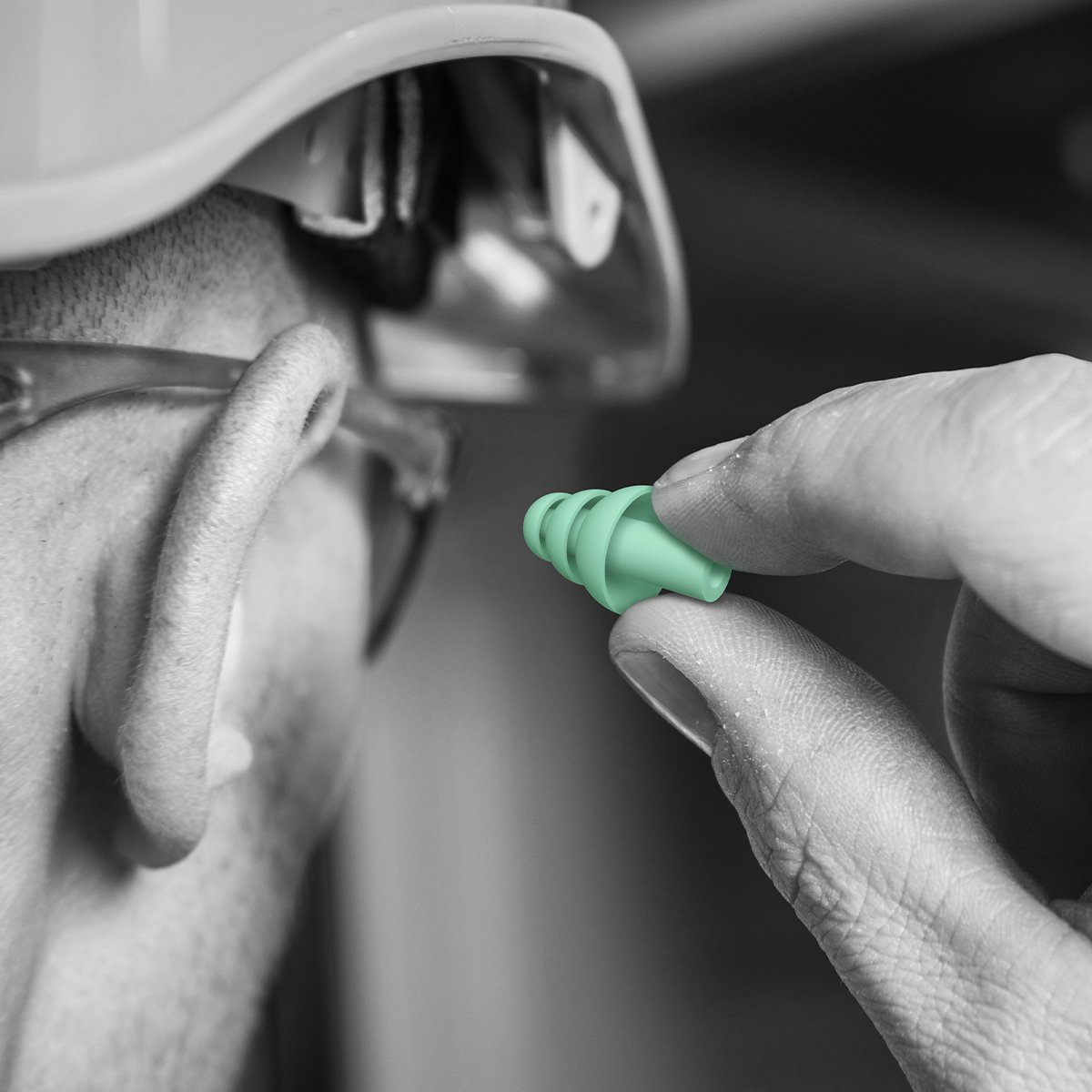
Yes, better earplugs genuinely improve hearing protection compliance. Workers skip or remove uncomfortable, muffling earplugs throughout the day, which means the protection rating on the box becomes meaningless in practice. High-fidelity earplugs that fit well and preserve natural sound quality remove the two biggest reasons workers resist wearing them: discomfort and the inability to communicate. The sections below break down exactly why compliance fails and what actually fixes it.
Why do workers skip hearing protection even when it’s available?
Workers skip hearing protection primarily because standard earplugs are uncomfortable to wear for hours and make it difficult to hear colleagues, warnings, or machinery feedback. When the cost of wearing protection feels higher than the perceived benefit, workers remove it or avoid it entirely. This is the core compliance problem in occupational hearing health.
The discomfort factor is more significant than most safety managers realize. Foam plugs expand and press against the ear canal, creating pressure that becomes genuinely painful after a few hours. Workers on long shifts face a simple calculation: tolerate the discomfort or take the plugs out. Most choose the latter, especially when no one is watching.
Communication is the other major barrier. Workers in manufacturing, construction, and other loud environments need to talk to colleagues, respond to supervisors, and listen for equipment sounds that signal problems. Standard foam plugs block so much sound indiscriminately that workers feel isolated and miss important audio cues. Removing the plugs to have a conversation quickly becomes a habit, and once they are out, they often stay out.
There is also a perception issue. Many workers genuinely do not believe that the noise levels they work in will cause lasting damage, particularly when the damage accumulates slowly over years rather than causing immediate pain. Without visible, immediate consequences, the motivation to endure uncomfortable protection is low.
What makes an earplug comfortable enough to wear all day?
An earplug is comfortable enough for all-day wear when it creates a secure seal without sustained pressure on the ear canal, uses soft, hypoallergenic materials, and fits the individual ear shape without requiring constant readjustment. Comfort over an eight-hour shift is a design challenge, not just a materials one.
Material matters enormously. Foam expands and pushes outward, generating pressure that increases over time. Silicone is softer but often too slippery to maintain a consistent seal. Synthetic rubber with higher density sits differently in the ear canal, conforming to the shape without the same outward pressure, which is why workers report significantly less fatigue when wearing it through a full shift.
Fit consistency is equally important. An earplug that shifts position throughout the day requires repeated reinsertion, which is both annoying and reduces protection reliability. Earplugs with a stable fit that workers can trust stay in place without constant attention become part of the background rather than a constant irritant.
Hypoallergenic construction matters for workers with sensitive ears or skin conditions. Allergic reactions to earplug materials are a real but underreported reason why some workers avoid protection altogether. Switching to hypoallergenic materials removes this barrier entirely for a meaningful portion of the workforce.
How does sound quality affect hearing protection compliance?
Sound quality directly affects compliance because workers who cannot communicate clearly, hear machinery feedback, or understand spoken instructions will remove their earplugs to do their jobs effectively. Hearing protection that degrades sound quality too severely creates a practical conflict between safety and job performance, and job performance usually wins.
Standard foam plugs block noise across the entire frequency spectrum without discrimination. This means voices become muffled and hard to distinguish, low-frequency machinery hum gets through while higher-frequency speech gets blocked, and the overall soundscape becomes distorted and disorienting. Workers describe it as feeling underwater, which is both unpleasant and practically limiting.
High-fidelity earplugs reduce overall volume while preserving the frequency balance of sound. The result is that speech remains intelligible, warning signals remain recognizable, and the working environment sounds like a quieter version of itself rather than a distorted one. Workers who can still communicate and monitor their environment have no practical reason to remove their protection.
This is not a minor quality-of-life improvement. When workers can hold a normal conversation without removing their earplugs, compliance rates improve because the protection stops competing with the job. The earplug becomes a tool rather than an obstacle.
What’s the difference between high-fidelity earplugs and standard foam plugs?
The key difference between high-fidelity earplugs and standard foam plugs is how they handle sound. Foam plugs block noise by absorbing and muffling all sound frequencies indiscriminately, resulting in distorted, muffled hearing. High-fidelity earplugs use acoustic filters to reduce volume evenly across frequencies, preserving sound clarity while still providing meaningful noise reduction.
Standard foam plugs are inexpensive and widely available, which is why they dominate occupational settings. They achieve high noise reduction ratings on paper by blocking sound aggressively, but the real-world experience is a heavily distorted soundscape that makes communication difficult and situational awareness poor. They are also single-use in most applications, generating significant waste and ongoing cost.
High-fidelity earplugs use a filter, typically positioned inside the earplug body, that shapes how sound passes through rather than simply blocking it. The filter design determines how well the earplug preserves frequency balance. A well-designed filter reduces volume without breaking up the sound wave, so the listener hears a quieter but accurate version of the environment rather than a muffled one.
Durability is another meaningful difference. Foam plugs are designed for single or very limited use. Reusable high-fidelity earplugs made from durable synthetic materials can last well over a year with proper care, which changes the cost calculation significantly when you factor in replacement frequency across an entire workforce.
Which industries have the biggest hearing protection compliance problem?
Manufacturing, construction, and heavy industry consistently show the lowest hearing protection compliance rates. These sectors combine prolonged exposure to high noise levels, physically demanding work that makes discomfort less tolerable, and strong communication requirements that conflict with standard earplug use. Together, these factors create persistent compliance challenges that safety equipment alone cannot solve.
In manufacturing environments, workers operate loud machinery for full shifts and need to hear equipment feedback, alarms, and colleague communication simultaneously. Standard foam plugs interfere with all of these, so workers develop habits of partial insertion or intermittent use that dramatically reduce real-world protection.
Construction sites present a different challenge. Workers move between very loud zones and quieter areas throughout the day, and the effort of inserting and removing foam plugs repeatedly leads many to stop wearing them altogether. Earplugs that can be worn comfortably across varying noise environments without constant removal and reinsertion reduce this friction.
Live music and entertainment venues, while not industrial, also face significant compliance issues among staff. Sound engineers, venue workers, and performers are exposed to sustained high volumes but often resist protection because standard plugs compromise the audio quality they need to do their jobs. This is a sector where high-fidelity protection has a particularly strong case to make.
Can better earplugs actually reduce long-term hearing damage rates?
Yes, better earplugs reduce long-term hearing damage rates when they improve real-world compliance. A high-rated earplug that workers remove regularly provides far less actual protection than a lower-rated earplug worn consistently throughout the shift. The protection that matters is the protection that stays in, which makes comfort and usability directly connected to health outcomes.
Noise-induced hearing loss is cumulative and irreversible. Damage builds over years of repeated exposure, and there is no treatment that restores lost hearing. This makes consistent daily protection far more valuable than occasional use of even the best-rated equipment. The gap between nominal protection ratings and real-world protection is largely a compliance gap, and addressing that gap has direct health consequences.
Industry experience consistently shows that when workers are given earplugs they find comfortable and practical, wear rates increase substantially. Higher wear rates mean more hours of actual protection per shift, which directly reduces cumulative noise exposure over a career. The math is straightforward: more hours protected equals less total damage over time.
The design of the earplug also affects whether protection is maintained correctly. Earplugs that are easy to insert properly and maintain a consistent seal throughout the day provide more reliable protection than those requiring careful technique to achieve the rated performance. Ease of correct use is part of what makes a better earplug genuinely more protective in practice.
If you are looking for a practical solution to hearing protection compliance in your workplace, our Shush Worker earplugs are built specifically for this challenge. With an SNR of 23 dB, a ceramic filter that preserves clear, natural sound, and hypoallergenic synthetic rubber construction rated for at least 365 days of use, they address the comfort and sound quality barriers that drive non-compliance. Workers can communicate, monitor their environment, and wear them through a full shift without the discomfort that sends standard earplugs into a pocket instead of an ear.
Frequently Asked Questions
How do I get my team to actually start wearing high-fidelity earplugs after years of resisting standard foam plugs?
Start with a trial period where workers can wear the new earplugs for a full shift before any formal rollout. Letting workers experience the difference in comfort and sound quality firsthand is far more persuasive than any top-down mandate. Pairing the trial with a brief explanation of why these earplugs feel and sound different helps workers understand what they are experiencing, which builds buy-in rather than resistance.
What noise reduction rating (NRR or SNR) should I look for when choosing earplugs for an industrial workplace?
For most industrial environments, an SNR between 20 and 30 dB or an NRR between 25 and 33 provides meaningful protection without over-attenuating sound to the point where communication becomes impossible. Regulatory bodies like OSHA require that workers be protected down to 90 dB or lower during an eight-hour shift, so the right rating depends on your specific noise levels. A safety manager or industrial hygienist can measure your workplace noise levels and match the appropriate protection rating to the actual exposure, rather than defaulting to the highest-rated option available.
Can workers wear high-fidelity earplugs alongside other personal protective equipment like hard hats or safety glasses without fit issues?
Yes, most high-fidelity earplugs designed for occupational use are compatible with hard hats, safety glasses, and face shields because they sit entirely within the ear canal rather than resting against the outer ear. Unlike earmuffs, which can break their seal when pressed against glasses or helmet straps, in-ear designs are largely unaffected by other PPE. It is still worth having workers test the combination during a trial shift to confirm fit and seal are not compromised by their specific gear configuration.
How do I know if workers are inserting their earplugs correctly, and what happens to protection levels if they are not?
Incorrect insertion is one of the most common and underestimated sources of reduced protection in the workplace. A properly inserted earplug should sit deep enough in the canal to create a full seal, and workers should not be able to hear a significant difference when they cup their hands over their ears after insertion. Many manufacturers and safety programs offer fit-testing tools or simple field checks that verify whether a seal is achieved. Training workers on correct insertion technique during onboarding and refreshing it periodically can meaningfully close the gap between rated and real-world protection.
Are reusable earplugs actually more hygienic than disposable foam plugs, or is that a common misconception?
Reusable earplugs can be more hygienic than disposable foam plugs when workers clean them consistently, but they can also become a hygiene concern if they are not maintained properly. The key advantage of a well-designed reusable earplug is that it is made from non-porous materials that can be wiped down or rinsed between uses, unlike foam which absorbs moisture, earwax, and bacteria and cannot be effectively cleaned. Providing workers with a simple cleaning routine and a storage case goes a long way toward keeping reusable earplugs genuinely hygienic across their rated lifespan.
What's the biggest mistake safety managers make when trying to improve hearing protection compliance?
The most common mistake is treating hearing protection compliance as a discipline problem rather than a design problem. Issuing warnings or increasing monitoring addresses the symptom without fixing the root cause, which is that standard earplugs are genuinely difficult to wear all day without sacrificing comfort or job performance. Switching to earplugs that workers actually want to wear because they are comfortable and do not interfere with communication consistently produces better compliance outcomes than enforcement alone. The goal is to remove the practical reasons workers resist protection, not just add consequences for non-compliance.
How long does noise-induced hearing loss take to develop, and at what point does it become noticeable to the worker?
Noise-induced hearing loss typically develops over years or even decades of repeated exposure, which is exactly what makes it so easy to underestimate until significant damage has already occurred. Early-stage loss often affects high-frequency sounds first, meaning workers may notice difficulty hearing certain consonants or following conversations in noisy environments before they recognize it as hearing loss. By the time a worker notices a clear problem, a substantial and permanent reduction in hearing function has usually already taken place, which is why consistent daily protection throughout a career matters far more than occasional use.
Related Articles
- What are the most comfortable earplugs that stay in?
- What earplugs are best for factory workers?
- Why do my earplugs keep falling out at work?
- Do earplugs come in different sizes?
- How loud is a typical nightclub compared to safe hearing levels?
- What is noise-induced hearing loss and can concerts cause it?
- How do DJs protect their hearing during long sets?
- What happens to sound quality when you wear the wrong earplugs?
- Are foam earplugs good enough for stadium concerts?
- What are the early signs of hearing damage from clubbing?
- Can wearing earplugs that preserve music clarity improve your concert experience?
- Can concert earplugs help with sensory overload at live events?
- Do earplugs affect your ability to communicate with people at loud events?
- How many hours in a nightclub is too long without ear protection?
- How do high-fidelity earplugs differ from regular foam ones?