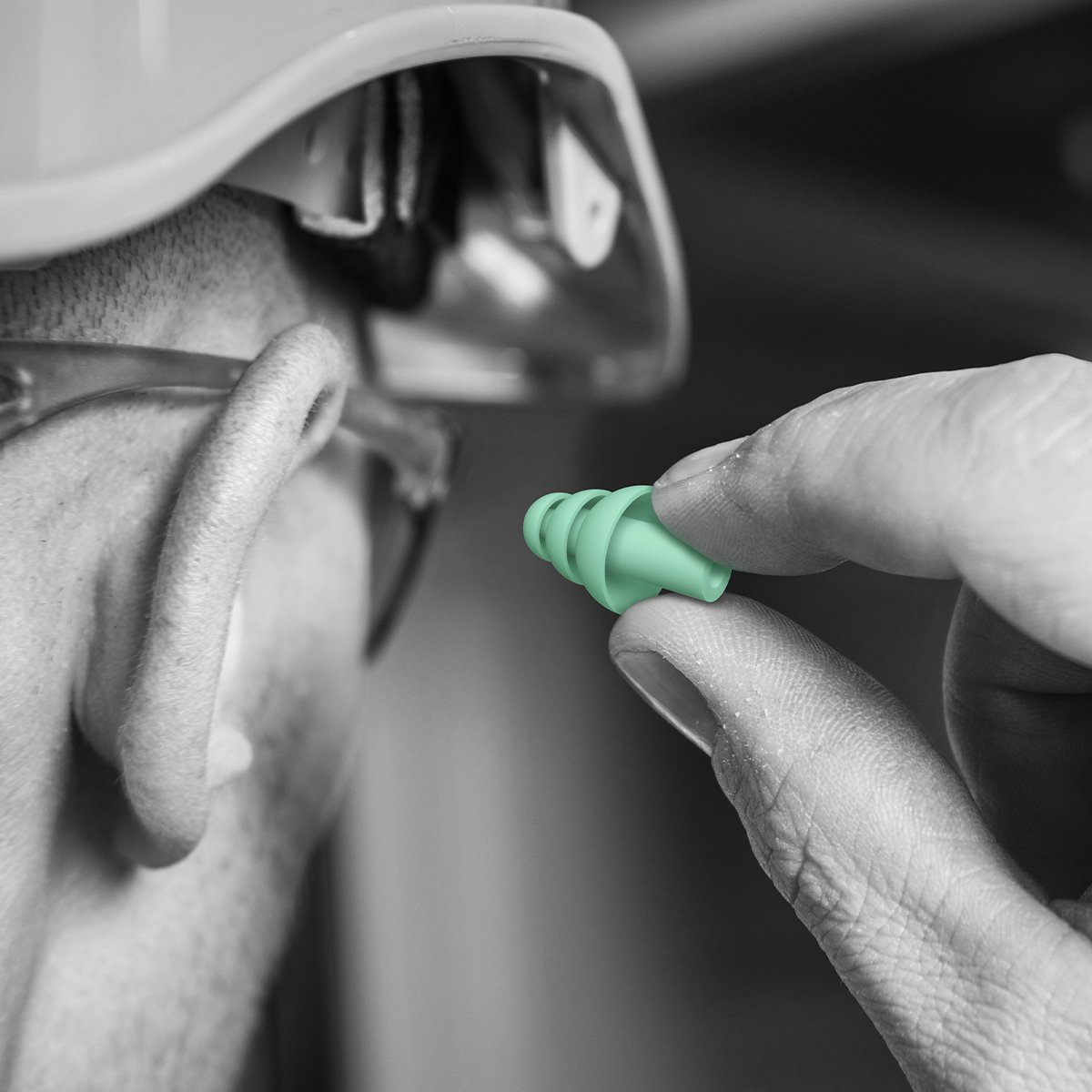
To ensure hearing protection compliance on a job site, you need to combine regulatory awareness, proper noise monitoring, the right protective equipment, and consistent enforcement. OSHA sets clear noise exposure limits, and employers are legally required to implement a hearing conservation program when those limits are met or exceeded. The sections below walk through each part of that process, from measuring noise levels to documenting compliance.
What are OSHA’s requirements for hearing protection on job sites?
OSHA requires employers to implement hearing protection measures when workers are exposed to noise at or above 85 decibels, averaged over an 8-hour workday, known as the action level. When exposure reaches 90 dB as a time-weighted average, employers must provide hearing protection and use engineering or administrative controls to reduce noise. These rules fall under OSHA’s Occupational Noise Exposure Standard, 29 CFR 1910.95 for general industry and 29 CFR 1926.52 for construction.
At the action level of 85 dB, employers must establish a hearing conservation program, provide audiometric testing, offer hearing protection, and train workers. At 90 dB and above, wearing protection becomes mandatory rather than optional. OSHA also sets a permissible exposure limit (PEL) of 90 dB for an 8-hour shift, with shorter allowable exposure times as noise levels increase. At 100 dB, for example, the maximum permitted exposure without protection drops to just 2 hours.
Employers who fail to meet these standards face citations and fines. More importantly, workers in non-compliant environments face real, permanent hearing loss. Noise-induced hearing damage is cumulative and irreversible, which is exactly why the regulations exist.
How do you measure noise levels to determine who needs protection?
Noise levels on a job site are measured using a sound level meter or a personal noise dosimeter. A sound level meter gives you an instant reading of noise in decibels at a specific location, while a dosimeter is worn by a worker throughout their shift to capture their actual personal exposure over time. Both tools are used together to get a complete picture of noise hazards across the site.
Start by walking the site and taking spot readings in areas where machinery, tools, or equipment are in use. Any area that registers above 85 dB warrants further investigation. For workers who move between areas or whose noise exposure varies throughout the day, dosimetry provides a more accurate measurement of their cumulative exposure.
Noise surveys should be repeated whenever there are changes to the work environment, new equipment is introduced, or processes shift in ways that could affect noise output. Keeping records of each survey allows you to track trends, identify problem areas, and demonstrate due diligence if your program is ever audited.
What types of hearing protection are approved for workplace use?
Approved hearing protection for workplace use falls into three main categories: earplugs, earmuffs, and canal caps. Each type carries a Noise Reduction Rating (NRR) assigned through standardized testing, which indicates how much noise the device reduces under laboratory conditions. OSHA requires that hearing protection provide enough attenuation to bring a worker’s exposure below the 90 dB PEL, and ideally below the 85 dB action level.
Earplugs
Earplugs are inserted into the ear canal and come in disposable foam versions, reusable pre-molded options, and high-fidelity designs. Foam earplugs typically offer high NRR values but can muffle communication and sound awareness, which creates safety risks in environments where workers need to hear alarms or instructions. Reusable earplugs made from durable synthetic materials offer a better balance of protection, comfort, and sound clarity, making them more practical for full-shift wear.
Earmuffs
Earmuffs fit over the entire outer ear and are easier to put on and take off consistently, which can help with compliance. They are a good option in environments where workers need to remove and replace protection frequently, though they can become uncomfortable in hot conditions and may not seal properly over facial hair or safety glasses.
For environments requiring very high attenuation, earplugs and earmuffs can be worn together. In this dual-protection setup, the combined NRR is not simply added together, but the additional protection is meaningful for extreme noise environments above 105 dB.
How do you get workers to actually wear their hearing protection?
Getting workers to consistently wear hearing protection comes down to three things: making it comfortable, making it accessible, and making it a clear expectation. Workers who find their earplugs uncomfortable or difficult to use will remove them at the first opportunity. Providing protection that fits well and does not muffle communication removes the main reasons workers resist wearing it.
Involve workers in selecting the hearing protection you provide. When people have a say in what they wear, they are more likely to use it. Offer a few options that meet the required NRR so workers can choose what fits their ears and their work style best.
Supervisors play a direct role in compliance. If a supervisor does not wear hearing protection in a noisy area, workers notice. Consistent modeling from site leadership sets a visible standard. Pair that with clear signage in hearing protection zones, easy access to supplies at multiple locations on site, and regular reminders during toolbox talks. Compliance improves when wearing protection becomes the obvious default rather than an extra step.
What should a hearing conservation program include?
A hearing conservation program must include noise monitoring, worker notification, audiometric testing, hearing protection provision, training, and recordkeeping. OSHA requires this program whenever workers are exposed at or above the 85 dB action level. Each component serves a specific function, and all of them need to be in place for the program to meet regulatory requirements.
- Noise monitoring: Regular measurement of noise levels across the site to identify who is exposed and at what levels.
- Worker notification: Informing workers of their noise exposure results and what those results mean for their health.
- Audiometric testing: Annual hearing tests for all workers exposed at or above the action level, with a baseline test conducted within 6 months of first exposure.
- Hearing protection: Providing a variety of effective options at no cost to workers, with guidance on proper use and fit.
- Training: Annual training on the effects of noise on hearing, how to use and care for hearing protection, and the purpose of audiometric testing.
- Recordkeeping: Maintaining noise exposure records for at least 2 years and audiometric test records for the duration of employment plus 30 years.
The program should be reviewed and updated regularly. If audiometric testing reveals a standard threshold shift, meaning a significant change in a worker’s hearing, the program needs to respond with follow-up testing and increased protective measures.
How do you document and track hearing protection compliance?
Documenting hearing protection compliance means keeping written records of noise surveys, exposure assessments, audiometric test results, training sessions, and equipment issued to workers. These records demonstrate that your program meets OSHA requirements and protect both the employer and employees if a dispute or audit arises. Good documentation also helps you spot patterns, such as a particular area of the site where exposure is consistently high.
A practical tracking system does not need to be complicated. A combination of sign-in sheets for training sessions, equipment issue logs, and digital records of noise monitoring results covers the core requirements. Many safety management platforms allow you to store and retrieve these records easily, which simplifies audit preparation.
Audiometric testing records deserve particular attention. If a worker develops a standard threshold shift, you are required to notify them in writing within 21 days of confirming the result. Keeping a clear timeline of test dates, results, and any follow-up actions protects you legally and shows a genuine commitment to worker health.
Hearing protection compliance is an ongoing process, not a one-time checklist. Regular site walkthroughs, refresher training, and prompt responses to new noise hazards keep the program active and effective. If you are looking for hearing protection that workers will actually want to wear all day, our Shush Worker earplugs are built for exactly that. Made from durable hypoallergenic synthetic rubber with an SNR of 23 dB and a ceramic filter that preserves clear, natural sound, they make full-shift compliance a lot more realistic for the people wearing them.
Frequently Asked Questions
What is the difference between NRR and SNR, and which one should I look for when buying hearing protection in the US?
NRR (Noise Reduction Rating) is the standard used in the United States and is required on all hearing protection sold domestically, while SNR (Single Number Rating) is the European equivalent. When purchasing hearing protection for a US job site, always reference the NRR. To estimate real-world protection, OSHA recommends derating the NRR by 50% to account for the difference between laboratory testing conditions and actual field use — so an earplug with an NRR of 30 dB provides an estimated 15 dB of practical attenuation.
How do I know if my current hearing protection is actually providing enough attenuation for my specific job site?
Start by comparing your workers’ measured noise exposure levels (from dosimetry readings) against the NRR of the protection being used, applying OSHA’s 50% derating factor. If the derated NRR does not bring exposure below 90 dB — and ideally below 85 dB — you need higher-rated protection or a dual-protection approach combining earplugs and earmuffs. If you are unsure, an industrial hygienist can conduct a formal noise exposure assessment and recommend appropriate protection for each role on your site.
What are the most common mistakes employers make when setting up a hearing conservation program for the first time?
The most common mistakes include conducting a one-time noise survey and never repeating it, failing to document worker notification of exposure results, and skipping baseline audiometric testing within the required 6-month window. Another frequent oversight is providing hearing protection without training workers on proper fit and insertion technique — an earplug worn incorrectly can lose most of its rated protection. Treating the program as a paperwork exercise rather than an active safety process is the root cause of most compliance failures.
Are there situations where engineering or administrative controls must be used instead of just relying on hearing protection?
Yes — OSHA’s hierarchy of controls requires that engineering and administrative controls be explored and implemented wherever feasible before relying solely on personal protective equipment like earplugs or earmuffs. Engineering controls include measures like isolating noisy machinery, adding sound barriers, or switching to quieter equipment. Administrative controls include rotating workers to limit individual exposure time. Hearing protection is considered the last line of defense, not a substitute for reducing noise at the source, particularly when exposures consistently exceed the 90 dB PEL.
What happens if a worker refuses to wear hearing protection in a designated hearing protection zone?
An employer’s responsibility does not end at providing hearing protection — OSHA requires that use be enforced when exposure is at or above the 90 dB PEL. If a worker refuses to comply, the situation should be addressed through your site’s disciplinary process, documented in writing, and escalated if the refusal continues. Consistent enforcement is also a legal protection for the employer; documented evidence that PPE was provided, training was given, and non-compliance was addressed can significantly reduce liability if a worker later files a hearing loss claim.
How should I handle a situation where a worker's audiometric test shows a standard threshold shift?
When a standard threshold shift (STS) is confirmed — defined by OSHA as an average shift of 10 dB or more at 2,000, 3,000, and 4,000 Hz in either ear — you are required to notify the affected worker in writing within 21 days. You must also refit or retrain them on hearing protection, consider whether their current protection is adequate, and refer them for further audiological evaluation if needed. An STS is a clear signal that your program needs to be reviewed for that worker’s specific exposure conditions, and it should prompt a closer look at the areas of the site where they work.
Can small contractors or self-employed workers on a job site be held to the same OSHA hearing protection standards?
Yes — OSHA’s noise exposure standards apply to all employers covered under the OSH Act, regardless of company size. Small contractors with even one employee are subject to the same 29 CFR 1910.95 or 29 CFR 1926.52 requirements as large companies. Self-employed individuals with no employees are not covered by OSHA directly, but general contractors overseeing a multi-employer job site can be held responsible for ensuring that all workers on site — including subcontractors — are protected from noise hazards under their control.
Related Articles
- Are foam earplugs good enough for power tools?
- Can I wear earplugs while using a circular saw?
- Does reducing workplace noise improve productivity?
- Can you reverse hearing damage from loud environments?
- Can ringing ears after a festival become permanent?
- How do musicians on stage avoid hearing damage during live shows?
- Can a single loud concert damage your hearing permanently?
- What should you look for when buying earplugs for music sound protection in 2026?
- How do bartenders and club staff protect their hearing at work?
- Are custom-molded earplugs a good investment for frequent clubbers?
- Are foam earplugs good enough for stadium concerts?
- Should you wear earplugs at a club even if you stand far from the speakers?
- What causes hearing loss at loud concerts?
- Can ear protection for clubbing still let you feel the bass?
- Can concert earplugs help people with anxiety in loud crowd environments?