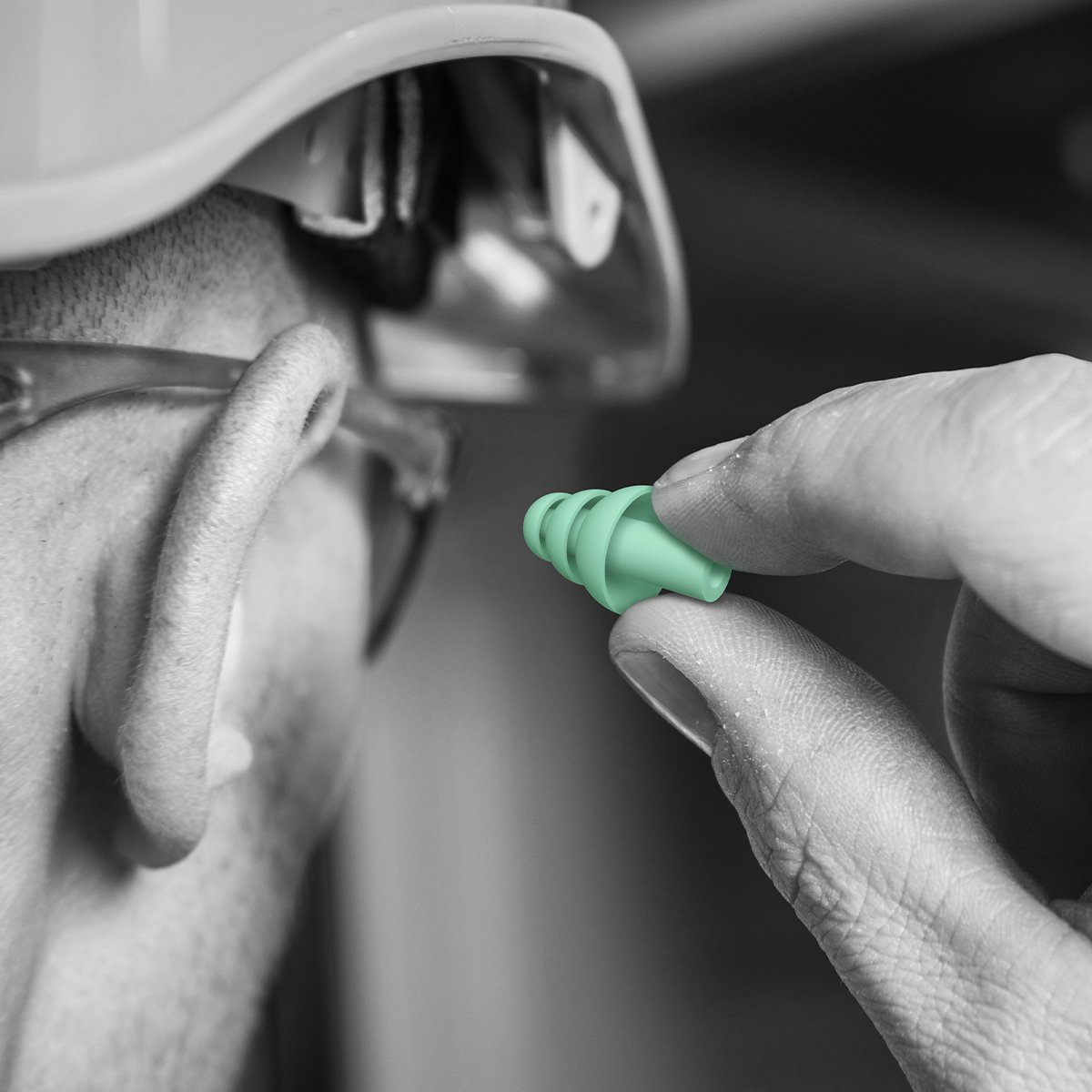
Under OSHA’s Occupational Noise Exposure Standard (29 CFR 1910.95), employers are legally required to protect workers from hazardous noise levels in the workplace. The rule applies to any general industry workplace where workers are exposed to noise at or above 85 decibels, averaged over an 8-hour workday. From employer obligations and noise thresholds to acceptable types of hearing protection, here is what the law actually requires.
What does OSHA require employers to do about workplace noise?
OSHA requires employers to monitor workplace noise levels, implement feasible engineering and administrative controls to reduce noise, and establish a hearing conservation program when workers are regularly exposed to noise at or above 85 dB, averaged over an 8-hour shift. Employers must also provide hearing protectors free of charge and train workers on how to use them properly.
The regulation is built around a hierarchy of controls. Employers must first try to reduce noise at the source through engineering solutions, such as replacing loud machinery or adding sound barriers. When that is not fully feasible, administrative controls like rotating workers away from noisy areas can help limit exposure time. Hearing protection is the last line of defense, not the first option.
Employers are also required to keep records of noise exposure measurements and audiometric test results. These records must be retained for the duration of the affected worker’s employment, plus an additional 30 years for exposure records.
What noise levels legally require hearing protection at work?
Hearing protection becomes legally required under OSHA when a worker’s noise exposure reaches or exceeds 90 decibels as an 8-hour time-weighted average (TWA). However, employers must make hearing protectors available to workers exposed at 85 dB TWA or higher, even if wearing them is not yet mandatory at that threshold.
OSHA uses a 5 dB exchange rate, meaning every 5 dB increase in noise level cuts the allowable exposure time in half. At 90 dB, workers can be exposed for up to 8 hours. At 95 dB, that drops to 4 hours. At 100 dB, just 2 hours. At 115 dB, exposure must not exceed 15 minutes in any 8-hour period.
These thresholds apply to continuous, intermittent, and impulsive noise combined. Peak impulse noise above 140 dB is prohibited entirely, regardless of duration.
What must be included in a hearing conservation program?
A hearing conservation program is required whenever workers are exposed to noise at or above 85 dB TWA. It must include five core components: noise monitoring, audiometric testing, hearing protector provision, worker training, and recordkeeping.
- Noise monitoring: Employers must measure noise levels in areas where workers may be at risk, using approved methods that capture all continuous, intermittent, and impulsive noise sources.
- Audiometric testing: Workers in the program must receive a baseline hearing test within 6 months of first exposure, followed by annual tests to detect any standard threshold shift (STS) in hearing ability.
- Hearing protectors: Workers must be given a selection of hearing protection options that are appropriate for the noise levels they face, at no cost to the employee.
- Training: Annual training sessions must cover the effects of noise on hearing, the purpose and use of hearing protectors, and the audiometric testing process.
- Recordkeeping: Employers must document noise exposure measurements and audiometric test results and retain them for the required periods.
If an audiometric test reveals that a worker has experienced a standard threshold shift, the employer must notify that worker in writing within 21 days and take additional protective steps, which may include fitting the worker with more effective hearing protection.
Who is responsible for providing hearing protection — employer or employee?
Under OSHA regulations, the employer is responsible for providing hearing protection at no cost to the employee. Workers do not have to purchase their own earplugs or earmuffs to comply with workplace safety requirements. The employer must offer a variety of options so workers can choose what fits and works best for them.
That said, workers carry their own responsibility once protection is provided. Employees are required to wear hearing protection correctly when they are in areas where it is mandatory, follow the training they have received, and participate in audiometric testing when scheduled.
If a worker consistently refuses to wear provided hearing protection in a mandatory zone, the employer can take disciplinary action. But the obligation to supply, maintain, and train workers on that protection always sits with the employer.
What types of hearing protection are legally acceptable under OSHA?
OSHA accepts any hearing protection that adequately reduces a worker’s noise exposure to a safe level, as long as it has a verified Noise Reduction Rating (NRR). Acceptable types include disposable foam earplugs, reusable earplugs, semi-insert earplugs, and earmuffs. The key requirement is that the selected protector must reduce the worker’s actual noise exposure to below the permissible exposure limit.
When selecting hearing protection, employers must account for the real-world attenuation the device provides. OSHA recommends applying a 50% derating to the labeled NRR to reflect typical real-world performance, since lab-tested NRR values often overestimate protection in actual workplace conditions.
Hearing protectors must also be compatible with any other personal protective equipment the worker wears, such as hard hats or safety glasses. Comfort and fit matter too – a protector a worker refuses to wear because it is uncomfortable provides zero protection.
For workers in manufacturing and construction environments, reusable earplugs with a strong SNR or NRR rating are a practical and cost-effective option. Our Shush Worker earplugs are independently certified for occupational use and built from durable, hypoallergenic synthetic rubber that holds up to daily wear while keeping sound clear and natural so workers can still communicate on the job.
What happens if an employer doesn’t comply with hearing protection laws?
Employers who fail to comply with OSHA’s noise standard can face significant financial penalties and legal consequences. OSHA can issue citations for serious violations, with fines up to $16,550 per violation as of 2026. Willful or repeated violations can result in penalties up to $165,514 per violation.
Beyond financial penalties, non-compliant employers may be required to correct violations within a set timeframe and face follow-up inspections. In cases where workers suffer documented hearing loss linked to workplace noise, employers may also face workers’ compensation claims and civil liability.
OSHA inspections can be triggered by a formal worker complaint, a referral from another agency, or a routine programmed inspection of high-risk industries. Construction, manufacturing, and heavy industry are among the sectors that receive the most scrutiny for noise compliance.
The practical takeaway for employers is straightforward: investing in a proper hearing conservation program is far less costly than the penalties, legal exposure, and reputational damage that come with non-compliance. More importantly, it protects workers from permanent hearing damage that cannot be reversed once it occurs.
Frequently Asked Questions
How do I know if my workplace actually needs a hearing conservation program?
The clearest indicator is whether any workers are regularly exposed to noise at or above 85 dB averaged over an 8-hour shift. If you are unsure, the first step is to conduct a noise survey using a sound level meter or dosimeter — either through your own safety team or a certified industrial hygienist. Industries like manufacturing, construction, mining, and agriculture are common candidates, but any workplace with loud machinery, power tools, or high-traffic noise environments should be assessed.
What is a standard threshold shift (STS), and what does it mean for my workers?
A standard threshold shift is a change in hearing ability of 10 decibels or more, averaged across the 2,000, 3,000, and 4,000 Hz frequencies in either ear, compared to a worker’s baseline audiogram. It is a red flag that a worker’s hearing may be deteriorating due to noise exposure on the job. When an STS is identified, the employer must notify the affected worker in writing within 21 days and take corrective action — which may include refitting the worker with more effective hearing protection, retraining, or re-evaluating noise controls in their work area.
Can workers choose their own hearing protection, or does the employer decide what they wear?
OSHA requires employers to offer a selection of hearing protectors, but workers have the right to choose from the options provided based on what fits and feels comfortable to them. Giving workers some ownership over their choice is actually a best practice — a protector the worker finds comfortable and easy to use is far more likely to be worn consistently and correctly. Employers should ensure that every available option in that selection provides adequate attenuation for the specific noise levels in the worker’s environment.
What is the NRR, and how do I use it to pick the right hearing protection for my workplace?
The Noise Reduction Rating (NRR) is a standardized number printed on every hearing protector that indicates how many decibels of noise reduction the device can provide under controlled lab conditions. To estimate real-world protection, OSHA recommends derating the labeled NRR by 50% to account for improper fit and typical workplace wear. For example, an earplug with an NRR of 30 should be treated as providing roughly 15 dB of practical attenuation. You then subtract that adjusted figure from your measured workplace noise level to estimate the worker’s effective exposure — which must fall below the 90 dB permissible exposure limit.
What are the most common mistakes employers make when setting up a hearing conservation program?
One of the most frequent mistakes is treating hearing protection as the primary solution rather than the last resort — skipping the engineering and administrative controls that should come first in the hierarchy. Other common pitfalls include conducting a one-time noise survey and never updating it when equipment or work processes change, failing to follow up after a standard threshold shift is detected, and delivering annual training as a checkbox exercise rather than meaningful instruction. Recordkeeping gaps are also a common compliance failure that can become costly during an OSHA inspection.
Do OSHA's hearing protection rules apply to part-time or temporary workers?
Yes. OSHA’s noise standard applies to all workers exposed to hazardous noise levels in a covered workplace, regardless of their employment status. Part-time employees, temporary workers, and contractors working on-site are all entitled to the same protections as full-time staff if they are exposed to noise at or above the action level. Employers and staffing agencies may share compliance responsibilities for temporary workers, but the host employer is generally responsible for ensuring that on-site noise controls and hearing protection requirements are met.
How often should workplace noise levels be re-measured after the initial monitoring is done?
OSHA requires employers to repeat noise monitoring whenever a change in production processes, equipment, or controls could result in new or higher noise exposures that may affect workers not previously covered by the hearing conservation program. In practice, this means re-monitoring any time you introduce new machinery, modify workflows, change shift schedules, or expand operations into new areas. Even without major changes, periodic re-monitoring — typically every one to three years depending on industry risk level — is considered a best practice to ensure your program reflects current conditions.
Related Articles
- Are reusable earplugs worth it for home use?
- Can I wear earplugs while using a circular saw?
- Are there earplugs comfortable enough for a full 8-hour shift?
- What are the most comfortable earplugs for long shifts?
- Are reusable earplugs more cost-effective than disposables for teams?
- Can noise exposure affect sleep quality in workers?
- Can you buy earplugs in bulk for employees?
- How do DJs protect their hearing during long sets?
- Can earplugs for music protection reduce listening fatigue during long shows?
- How do bartenders and club staff protect their hearing at work?
- What type of ear protection works best in a nightclub?
- How do sound engineers and event crew protect their hearing at stadium shows?
- Do earplugs change how electronic music sounds at a live EDM event?
- What is the difference between foam and high-fidelity festival earplugs?
- Can ear protection for clubbing still let you feel the bass?