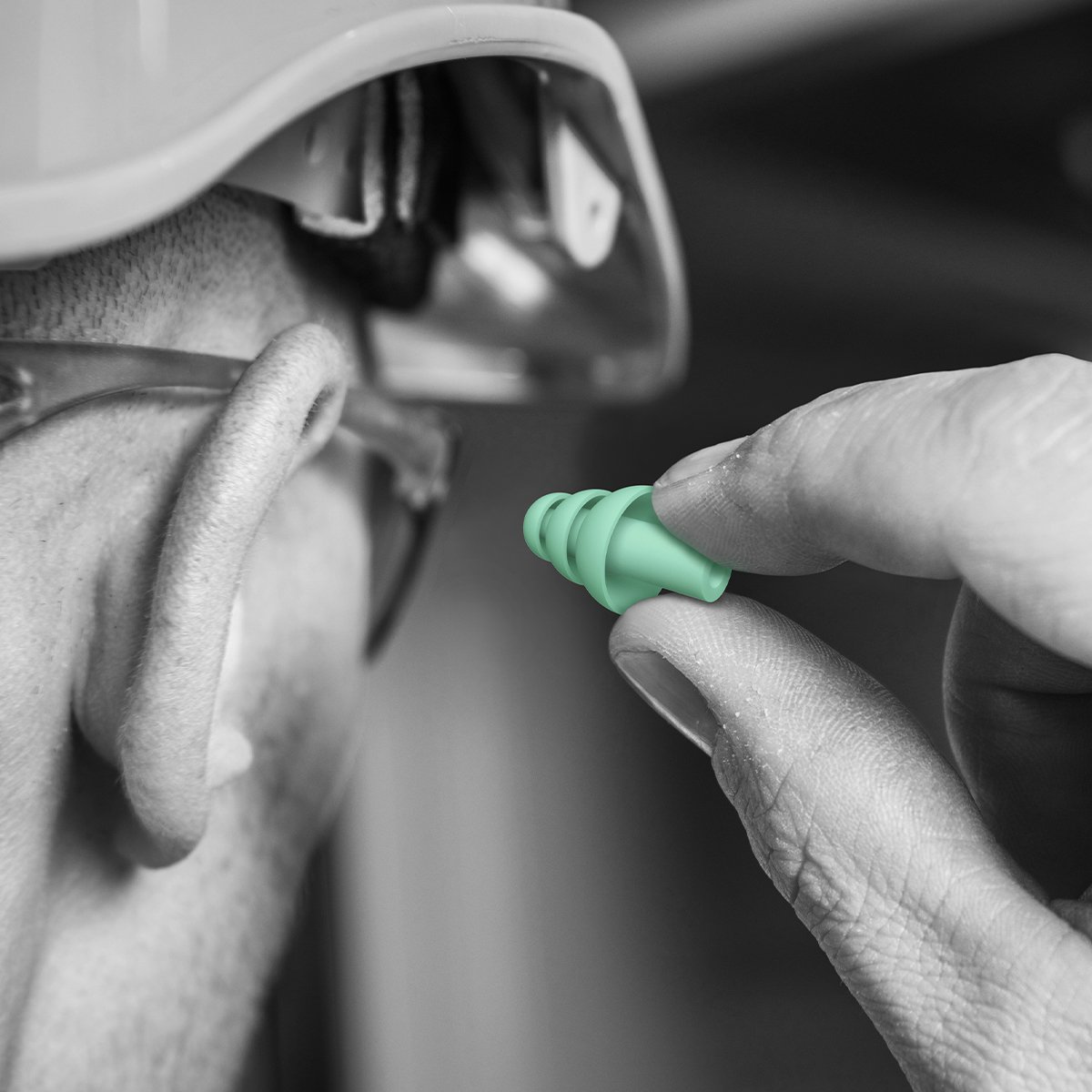
Noise becomes dangerous to hearing at 85 decibels (dB) or above. At that level, prolonged exposure starts to cause permanent damage to the hair cells inside your inner ear. The louder the sound, the faster the damage happens — and once those hair cells are gone, they do not grow back. Below, we break down how dB levels relate to hearing risk, what everyday sounds push past safe limits, and when wearing hearing protection actually makes a difference.
At what dB level does noise become dangerous to hearing?
Noise becomes dangerous to hearing at 85 dB. This is the threshold recognized by occupational health organizations worldwide as the point where sustained exposure begins to cause permanent hearing damage. Below 85 dB, most people can listen for extended periods without lasting harm. Above it, the risk grows quickly — with both volume and duration.
The relationship between loudness and damage is not linear. Every 3 dB increase doubles the sound energy reaching your ears. So 88 dB is twice as intense as 85 dB, and 91 dB is four times as intense. This is why even small jumps on the decibel scale carry a much bigger biological impact than the numbers suggest.
At 100 dB — a level common at concerts, motorsport events, and construction sites — damage can begin in as little as 15 minutes. At 110 dB, which many US venues regularly exceed, that window shrinks to under two minutes.
How long can you safely listen at different dB levels?
Safe listening time drops sharply as volume increases. At 85 dB, most guidelines allow up to 8 hours of exposure per day. At 88 dB, that drops to 4 hours. At 91 dB, 2 hours. The pattern continues: every 3 dB increase cuts the safe exposure time in half.
Here is a practical reference for daily exposure limits by dB level:
- 85 dB — up to 8 hours
- 88 dB — up to 4 hours
- 91 dB — up to 2 hours
- 94 dB — up to 1 hour
- 97 dB — up to 30 minutes
- 100 dB — up to 15 minutes
- 110 dB — under 2 minutes
- 120 dB and above — immediate risk of damage
These limits apply to continuous exposure. Brief spikes at high dB levels — like a gunshot or a sudden burst of power tool noise — can cause instant damage even without sustained exposure. The key takeaway is that time and volume work together. Reducing either one reduces your total noise dose for the day.
What everyday sounds exceed safe decibel levels?
Many common sounds in daily life push well past the 85 dB safety threshold. Is power tool noise dangerous? Yes — most power tools operate between 90 and 110 dB, which puts them firmly in the range where hearing damage accumulates with regular use. A drill, circular saw, or leaf blower can all exceed safe limits within minutes of operation.
Other everyday sounds that regularly exceed 85 dB include:
- Lawn mowers and garden equipment — typically 90 to 100 dB
- Motorcycles and heavy traffic — 85 to 95 dB, especially at highway speeds
- Live music and concerts — commonly 100 to 115 dB
- Nightclubs and bars — often 95 to 110 dB
- Headphones at high volume — can reach 100 to 110 dB easily
- Construction and heavy machinery — 95 to 120 dB depending on the equipment
- Sporting events and stadiums — frequently 100 dB or higher
The problem with many of these exposures is that they feel normal. People spend hours at concerts, mow the lawn every weekend, or work with power tools regularly without thinking twice about their hearing. The damage is cumulative and silent — you often do not notice it until years later.
What happens to your ears when exposed to loud noise?
When you are exposed to loud noise, the tiny hair cells in your cochlea — the spiral-shaped structure in your inner ear — bend and vibrate with the sound waves. At safe volumes, they recover. At dangerous volumes, they become overstimulated, and the physical stress starts to break them down. Once enough of these cells are damaged, your ability to hear certain frequencies decreases permanently.
In the short term, you might notice a ringing or buzzing sound after a loud event — this is called tinnitus, and it is a warning sign that your ears have been stressed. You might also experience a temporary threshold shift, where sounds seem muffled or quieter than normal for a few hours afterward. This temporary muffling can feel harmless, but repeated episodes gradually become permanent.
Over time, noise-induced hearing loss tends to affect high-frequency sounds first — the consonants in speech, the clarity of voices in a crowd, the detail in music. It is gradual enough that many people do not notice until the loss is significant. By then, the damage is done.
Can you recover from noise-induced hearing damage?
Permanent noise-induced hearing loss cannot be reversed. The hair cells in your inner ear do not regenerate once they are destroyed. What feels like a temporary hearing dip after a loud event — that muffled sensation or ringing — can recover within hours or days, but repeated exposure gradually turns temporary damage into permanent loss.
There is currently no approved medical treatment that restores hearing lost through noise exposure. Hearing aids and cochlear implants can help manage the impact, but they compensate for the loss rather than fixing it. Research into hair cell regeneration is ongoing, but no viable treatment is available to consumers in 2026.
The practical implication is straightforward: prevention is the only reliable strategy. Reducing your noise dose — either by lowering volume, limiting exposure time, or wearing hearing protection — is the only way to protect the hearing you have.
How many dB do earplugs actually reduce?
Standard foam earplugs typically reduce noise by 20 to 33 dB, depending on fit and construction. High-fidelity earplugs with acoustic filters generally reduce noise by 15 to 25 dB while preserving sound quality more evenly across frequencies. The actual protection you get depends heavily on the earplug’s design, material, and how well it seals in your ear canal.
The key number to look for is the SNR (Single Number Rating) in Europe or the NRR (Noise Reduction Rating) in the US. These ratings indicate how many decibels of protection the earplug provides under standardized test conditions. An earplug with an SNR of 23 dB worn at a 100 dB concert would bring your effective exposure down to around 77 dB — well within safe limits.
One important distinction is between flat-attenuation earplugs and standard foam plugs. Foam plugs reduce high frequencies much more aggressively than low ones, which makes everything sound muffled and unnatural. High-fidelity earplugs use acoustic filters to reduce volume more evenly, so sound stays clear and balanced rather than distorted. For anyone who needs to communicate, listen to music, or stay aware of their environment while protected, this difference matters significantly.
When should you wear hearing protection based on dB levels?
You should wear hearing protection whenever you expect to be in an environment that reaches or exceeds 85 dB for more than a few minutes. This applies whether you are at a concert, riding a motorcycle, operating power tools, or working near heavy machinery. If you are unsure about the noise level, a free decibel meter app on your phone can give you a reliable estimate.
Practical situations where hearing protection is worth wearing include:
- Using power tools for more than a few minutes — drills, saws, grinders, and sanders all exceed safe thresholds
- Attending live music events or nightclubs, where sound levels routinely hit 100 dB or more
- Riding a motorcycle, where wind noise at highway speed typically reaches 95 to 100 dB
- Working in manufacturing, construction, or any environment with continuous machinery noise
- Attending motorsport events, airshows, or shooting ranges
- Mowing the lawn or using a leaf blower regularly
For occupational settings in particular, consistent hearing protection is not optional — it is a long-term investment in your health. Our Shush Worker earplugs are built specifically for this kind of daily, demanding use. With an SNR of 23 dB, a ceramic filter that keeps sound clear and natural, and a hypoallergenic synthetic rubber construction rated for at least 365 days of reuse, they deliver real protection without the discomfort that makes people stop wearing them. Because the best hearing protection is the kind you actually keep in your ears.
Frequently Asked Questions
How do I know if my workplace is loud enough to require hearing protection?
The easiest way is to download a free decibel meter app — options like NIOSH SLM or Decibel X give reasonably accurate readings from your smartphone. As a rule of thumb, if you have to raise your voice to be heard by someone standing an arm’s length away, the environment is likely at or above 85 dB. In the US, OSHA requires employers to implement a hearing conservation program when workers are exposed to 85 dB or more averaged over an 8-hour workday, so your employer may already have noise monitoring data on file.
Can listening to music through headphones or earbuds cause the same kind of hearing damage as loud concerts?
Absolutely — headphones and earbuds are one of the most underestimated sources of noise-induced hearing loss, especially because the sound is delivered directly into the ear canal. At high volume settings, many consumer earbuds can reach 100 to 110 dB, which falls into the danger zone within minutes. A practical rule is the 60/60 guideline: keep volume at or below 60% of maximum and limit continuous listening sessions to 60 minutes before giving your ears a break.
What's the difference between NRR and SNR ratings on hearing protection, and which one should I pay attention to?
NRR (Noise Reduction Rating) is the standard used in the United States, while SNR (Single Number Rating) is used in Europe. Both measure how many decibels of protection the device provides, but they use different testing methods, so the numbers aren’t directly interchangeable. When shopping for hearing protection in the US, focus on the NRR — and keep in mind that real-world protection is typically about half the labeled NRR value due to fit variability, so an NRR 33 earplug realistically delivers closer to 16 dB of protection in everyday use.
Is it possible to wear hearing protection too much — could it make my ears more sensitive to noise over time?
No — wearing hearing protection does not make your ears more sensitive or dependent on it. Your auditory system does not recalibrate to quieter conditions in a way that increases vulnerability to normal sounds. The concern about over-reliance is more practical: in some work environments, blocking too much sound can reduce situational awareness and create safety risks. For everyday recreational or occupational use at dangerous noise levels, consistent protection is always the right call.
What are the most common mistakes people make when using foam earplugs that reduce their effectiveness?
The biggest mistake is improper insertion — most people don’t insert foam earplugs deeply enough into the ear canal to get a proper seal, which can cut the effective protection in half or more. The correct technique is to roll the earplug into a tight cylinder, reach over your head with the opposite hand to gently pull your ear upward and outward, then insert the earplug and hold it in place for 20 to 30 seconds while it expands. Using earplugs that are dirty, worn out, or the wrong size for your ear canal are also common issues that quietly reduce how well they actually work.
My ears ring after loud events but it goes away — does that mean my hearing is fine?
Not exactly. That post-event ringing — tinnitus — is your ears signaling that they’ve been stressed beyond their safe threshold. While the ringing fading overnight feels like a full recovery, research shows that repeated episodes of this temporary damage progressively erode hearing capacity, even before it shows up on a standard audiogram. Think of it like a sunburn: the redness fades, but cumulative sun exposure still causes lasting skin damage over time. If you’re regularly experiencing post-event ringing, it’s a strong signal to start wearing hearing protection consistently.
Are there situations where earmuffs are a better choice than earplugs?
Yes — earmuffs tend to be a better fit for situations involving very high-impact noise like shooting ranges or heavy industrial machinery, where maximum attenuation is the priority and you need to put protection on and take it off frequently. They’re also easier to use correctly since fit doesn’t depend on insertion technique. That said, earplugs generally offer better portability, comfort during extended wear, and compatibility with other gear like helmets or eye protection. For the highest-risk environments, combining both earmuffs and earplugs together can provide an additional 5 to 10 dB of combined protection.
Related Articles
- Can earplugs for concerts improve your listening experience?
- What do you give someone who already has everything for Christmas?
- What earplugs can I wear all day without discomfort?
- What earplugs are best for occasional power tool use?
- What earplugs are best for factory workers?
- What are the most comfortable earplugs for long shifts?
- How do you ensure hearing protection compliance on a job site?
- Why do my earplugs keep falling out at work?
- How do you use earplugs for festivals correctly?
- How do musicians on stage avoid hearing damage during live shows?
- How do filters in high-fidelity earplugs preserve sound quality?
- How do DJs protect their hearing during long sets?
- Can earplugs for music protection reduce listening fatigue during long shows?
- Are earplugs for going out worth buying if you only go out occasionally?
- Why do some concertgoers say earplugs make music sound better?