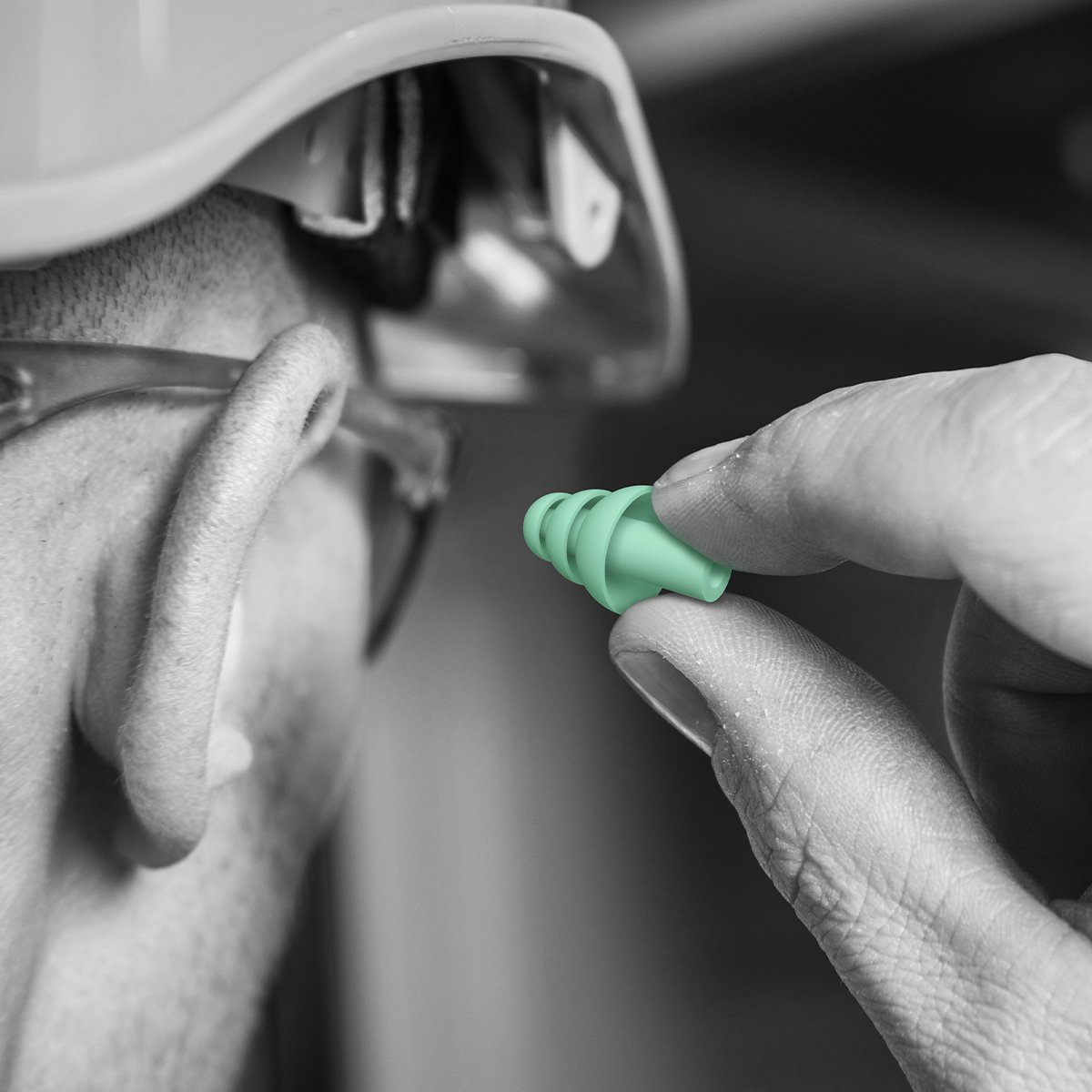
Yes, loud noise at work directly affects concentration. Noise forces your brain to spend extra cognitive energy filtering out unwanted sound, which leaves less mental bandwidth for the task at hand. This is true whether you work in a factory, on a construction site, or in a noisy open office. The sections below break down exactly what happens in your brain, which noise types are most disruptive, and what you can do about it.
How does loud noise physically affect the brain?
Loud noise triggers a physiological stress response in the brain. When your auditory system detects intense or unpredictable sound, the amygdala activates your fight-or-flight response, releasing cortisol and adrenaline. This keeps your nervous system in a low-level state of alertness, making it harder to enter the focused, calm mental state needed for complex tasks.
Beyond the stress response, sustained noise forces your prefrontal cortex to work harder. This part of the brain handles attention, decision-making, and working memory. When it has to continuously suppress irrelevant auditory input, the cognitive resources available for your actual work decrease noticeably. The result is slower thinking, more errors, and a feeling of mental exhaustion at the end of the day that feels disproportionate to what you actually accomplished.
Noise also disrupts the brain’s default mode network, which plays a role in consolidating information and generating creative ideas. Sustained noise exposure keeps the brain reactive rather than reflective, which is why loud work environments tend to suppress problem-solving and creative thinking over time.
What types of workplace noise are most distracting?
Unpredictable and intermittent noise is the most cognitively disruptive type of workplace sound. Irregular noise, such as sudden machinery bursts, alarms, or colleagues having nearby conversations, demands more brain processing than steady background noise because your auditory system cannot habituate to it. Speech, in particular, is among the most distracting sounds because the brain automatically tries to process language.
Research in cognitive psychology consistently shows that intelligible speech, even when you are not actively listening, competes directly with reading and writing tasks. This is why an open-plan office with nearby conversations can feel more disruptive than a construction site with consistent machinery noise.
The most cognitively damaging noise types in work environments include:
- Intermittent impact noise from tools, hammers, or machinery starting and stopping
- Nearby speech and conversation, especially when partially audible
- High-pitched mechanical noise from equipment like grinders or saws
- Alarm and alert sounds that trigger an automatic orienting response
- Low-frequency vibration noise from engines or HVAC systems, which is harder to consciously register but still affects focus
Does loud noise at work cause long-term hearing damage?
Yes, prolonged exposure to loud workplace noise causes permanent hearing damage. Noise-induced hearing loss occurs when intense sound damages the hair cells inside the cochlea, the sensory organ in your inner ear. These cells do not regenerate, meaning the damage is irreversible. Occupational noise exposure is one of the leading causes of preventable hearing loss worldwide.
The threshold for hearing damage depends on both the intensity of the sound and the duration of exposure. Sound levels above 85 decibels over an eight-hour workday are considered hazardous by occupational health standards. Heavy machinery, power tools, and industrial equipment routinely exceed this threshold, often reaching 95 to 110 dB or higher.
What makes occupational noise damage particularly concerning is that it accumulates gradually. Workers often do not notice any hearing loss until significant damage has already occurred. Early signs include difficulty understanding speech in noisy environments, ringing in the ears after shifts, and needing to turn up the volume on devices more than before. By the time these symptoms appear, years of cumulative exposure have typically already taken a toll.
Beyond hearing loss, chronic noise exposure at work is associated with elevated blood pressure, disrupted sleep, and increased cardiovascular risk, all of which are connected to how noise affects worker health over the long term.
Why do some people focus better in noise than others?
Individual differences in noise tolerance come down to a combination of neurology, personality, and prior habituation. People who score higher in introversion on personality assessments tend to have a lower optimal arousal threshold, meaning they reach cognitive overload from noise more quickly than extroverts. This is not a character flaw but a genuine neurological difference in how sensory input is processed.
Some people also develop habituation to specific types of noise through repeated exposure. A factory worker with years of experience may effectively filter out the hum of machinery that would derail a new employee. However, this habituation does not protect hearing. The brain learns to suppress conscious awareness of familiar noise, but the inner ear still receives the full acoustic impact.
Working memory capacity also plays a role. People with higher working memory capacity can suppress distracting auditory input more effectively, which is why the same noise level might barely register for one person while completely derailing another. Age is a further factor, as noise tolerance tends to decrease over time, partly due to accumulated hearing wear and partly due to changes in cognitive flexibility.
What can workers do to protect concentration in loud environments?
Workers can protect their concentration in loud environments by combining physical noise reduction with smart work habits. The most direct approach is using hearing protection that reduces overall sound volume without distorting the sounds you actually need to hear. Controlling when and where you do cognitively demanding tasks is equally important.
Practical steps that make a measurable difference include:
- Use hearing protection consistently, not just when noise feels uncomfortable. By the time noise feels painful, damage may already be occurring.
- Schedule deep-focus tasks during quieter periods in the workday, such as early morning or during breaks in machinery operation.
- Take regular breaks away from noisy areas. Even short periods of acoustic rest help the auditory system recover and reduce mental fatigue.
- Communicate with colleagues about noise patterns so that disruptive tasks are batched or scheduled predictably rather than occurring randomly.
- Address low-frequency vibration noise at the source where possible, since this type of noise is often overlooked but contributes to fatigue.
Building these habits consistently matters more than any single intervention. Noise-related cognitive fatigue compounds across a workweek, so small daily reductions in noise exposure add up to significantly better mental performance and lower health risk over time.
When should workers use hearing protection versus noise-canceling headphones?
Workers should use certified hearing protection whenever noise levels are at or above 85 dB, which is the standard threshold for occupational hearing risk. Noise-canceling headphones are designed for comfort in moderately noisy environments, like open offices or commutes, but they do not provide the attenuation levels required for industrial or construction settings. In genuinely hazardous noise environments, certified earplugs or earmuffs are the appropriate choice.
Noise-canceling headphones work by generating an inverse sound wave to cancel out ambient noise. They perform well against low-frequency, consistent sounds like HVAC systems or engine hum, but they are less effective against sharp, sudden, or high-frequency noise. In a factory or on a construction site, this limitation matters. A pair of consumer noise-canceling headphones may reduce perceived noise enough to feel comfortable while leaving the ear exposed to damaging sound pressure levels.
Certified hearing protection, by contrast, carries a tested and verified noise reduction rating. This gives workers and employers a reliable basis for knowing how much protection is actually being provided. For workers who also need to communicate with colleagues, the choice of earplug matters significantly. Standard foam plugs muffle all sound indiscriminately, making speech difficult to understand and encouraging workers to remove protection when they need to talk.
High-fidelity earplugs solve this problem by reducing overall volume while preserving sound clarity, so workers can still hear spoken instructions and warning signals without removing their protection. Our Shush Worker earplugs are built specifically for this balance, with an SNR of 23 dB and a ceramic filter design that keeps sound natural and clear rather than muffled. Made from durable hypoallergenic synthetic rubber, they are built for all-day wear and last at least 365 days, which makes them a practical and cost-effective solution for workers who need reliable protection every shift.
Frequently Asked Questions
How do I know if my workplace noise level is actually dangerous?
The most reliable way to know is to have your workplace noise levels measured with a sound level meter or dosimeter, which many occupational health and safety professionals can provide. As a general rule of thumb, if you have to raise your voice to be heard by someone standing three feet away, the ambient noise is likely at or above 85 dB — the threshold for hearing damage. Many employers are legally required under OSHA regulations to conduct noise assessments and inform workers when levels exceed safe limits, so checking with your safety officer is a practical first step.
Can the cognitive effects of noise-related fatigue be reversed after a workday?
Yes, most of the cognitive fatigue caused by noise exposure during a single workday is reversible with adequate rest, particularly sleep, which is when the brain consolidates information and recovers from stress-related activation. Spending time in quiet environments after work — even for 20 to 30 minutes — gives your auditory system and prefrontal cortex a chance to decompress. However, if loud noise exposure is chronic and ongoing over months or years, the cumulative effects on stress hormones, sleep quality, and cardiovascular health become harder to fully reverse, which is why daily prevention matters more than recovery.
What if my employer won't take noise concerns seriously — what are my options?
In the United States, workers have the right to a safe workplace under OSHA standards, which include specific regulations for occupational noise exposure (29 CFR 1910.95). If your employer is not addressing noise hazards, you can file a confidential complaint directly with OSHA, which will investigate without disclosing your identity. You can also request a workplace hazard assessment in writing, which creates a paper trail. Documenting the noise sources, your concerns, and any symptoms you experience is a smart protective step regardless of how your employer responds.
Are there specific tasks I should avoid doing in loud environments?
Yes — tasks that rely heavily on working memory, reading comprehension, writing, or complex problem-solving are the most vulnerable to noise interference and should be saved for quieter periods whenever possible. This includes things like drafting reports, analyzing data, learning new procedures, or making safety-critical decisions. Routine, well-practiced physical tasks are far less affected by noise because they rely on procedural memory rather than active cognitive processing. Structuring your day so that mentally demanding work happens during the quietest windows is one of the most effective and zero-cost strategies available.
Is it possible to get too used to loud noise and stop noticing the damage it's causing?
Absolutely, and this is one of the most important misconceptions to address. Habituation means your brain learns to suppress conscious awareness of familiar noise, so it stops feeling as bothersome over time — but your inner ear is still receiving the full acoustic impact with every shift. Workers who have spent years in loud environments often feel fine and report no hearing issues, yet audiological testing frequently reveals significant high-frequency hearing loss they were unaware of. The absence of discomfort is not evidence of safety, which is why consistent hearing protection matters even when the noise no longer feels loud.
Do earplugs affect communication and situational awareness on the job?
Standard foam earplugs can make speech harder to understand and may muffle important warning signals, which is a legitimate safety concern in many work environments and a common reason workers skip protection. However, this is largely a problem with the type of earplug rather than hearing protection in general. High-fidelity earplugs with acoustic filters reduce overall volume while keeping speech and environmental sounds clear and natural, allowing workers to hold conversations and hear alarms without removing their protection. Choosing the right type of earplug for your specific work environment makes a significant difference in both safety and day-to-day usability.
How long does it take for noise-induced hearing loss to develop, and will I feel it happening?
Noise-induced hearing loss typically develops gradually over years of repeated exposure, which is precisely what makes it so easy to miss until significant damage has already occurred. You will not feel it happening in the way you feel pain from an injury — the hair cells in your cochlea are destroyed silently and without sensation. Early warning signs include a temporary muffled or ringing sensation after loud shifts, difficulty following conversations in noisy settings, and gradually needing higher volumes on your phone or TV. If you notice any of these signs, scheduling a hearing evaluation with an audiologist as soon as possible can help establish a baseline and catch further deterioration early.
Related Articles
- What are the best earplugs for home use?
- What earplugs are best for factory workers?
- Are there earplugs comfortable enough for a full 8-hour shift?
- Does hearing damage from work build up over time?
- How do musicians protect their hearing at live shows?
- What is noise-induced hearing loss and can clubbing cause it?
- Should teenagers wear ear protection when going to nightclubs?
- Can earplugs for loud events still let you feel the crowd energy?
- Can earplugs for music protection reduce listening fatigue during long shows?
- How do you find earplugs that fit securely at a crowded EDM event?
- What type of ear protection works best in a nightclub?
- Are custom earplugs worth it for regular festival-goers?
- How does standing near speakers at a stadium concert affect hearing damage risk?
- Do earplugs for clubbing muffle the music too much?
- Can hearing damage from clubbing develop without you noticing?