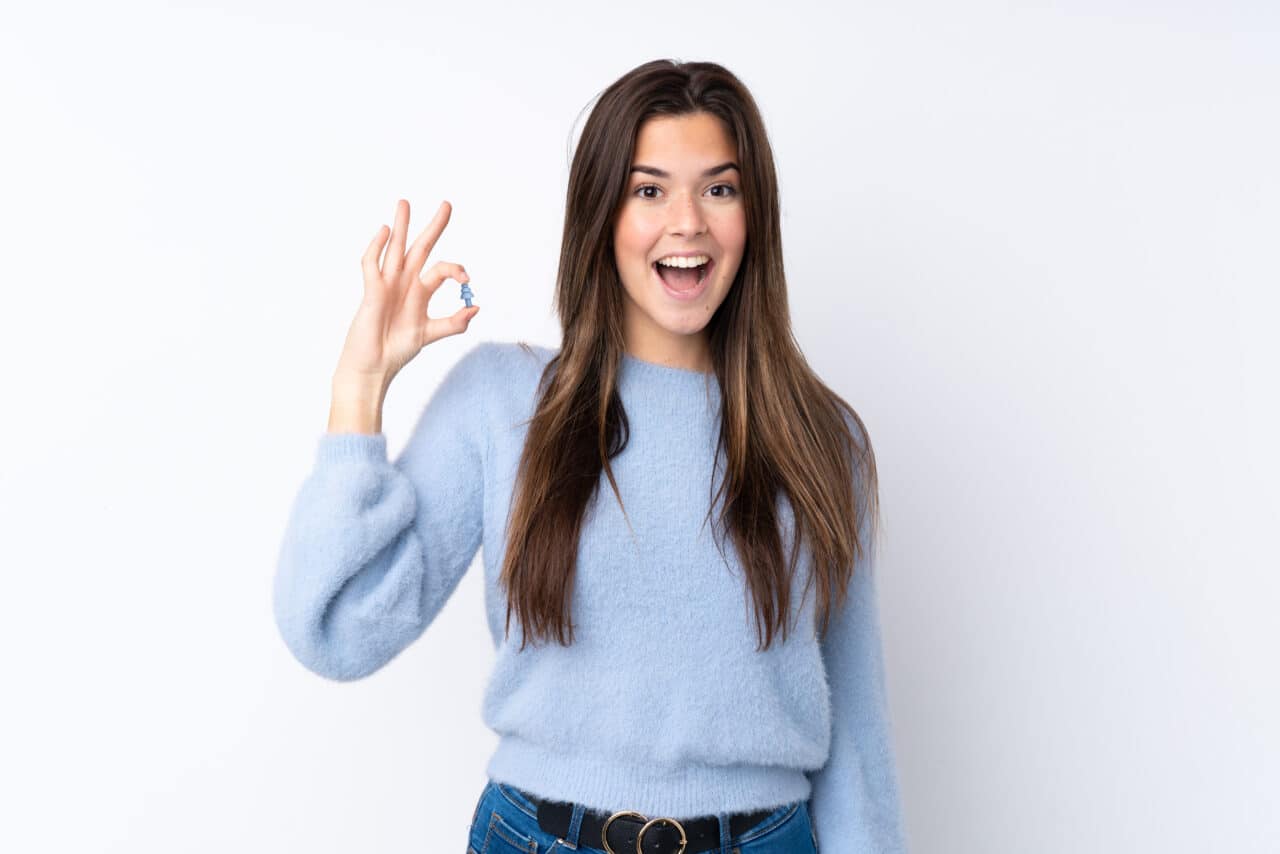
Festival earplugs are hearing protection devices designed specifically for loud music environments. Unlike standard foam earplugs, they use a special filter to reduce overall volume without muffling or distorting the sound. This means you can still hear the music clearly, follow conversations, and enjoy the full experience, just at a safer level. If you have ever walked out of a concert with ringing ears, festival earplugs are exactly what you need to keep that from happening again.
What are festival earplugs and how are they different from regular earplugs?
Festival earplugs, also called high-fidelity earplugs or music earplugs, are hearing protection tools built with one goal in mind: protecting your ears at loud events without ruining the sound. Regular foam earplugs block noise by absorbing sound waves across all frequencies, which is great for a construction site but terrible for a music festival. The result with foam is that everything sounds dull, distant, and distorted, like listening through a pillow.
Festival earplugs work differently. They use a filter, often made from ceramic or acoustic-grade materials, that reduces volume more evenly across all frequencies. The music stays balanced and clear. You hear the bass, the mids, the highs, just at a level that does not put your hearing at risk. That is the core difference: foam earplugs reduce noise, festival earplugs preserve sound while reducing noise.
How do festival earplugs work to protect your hearing?
The science behind festival earplugs comes down to how they manage sound waves. Standard earplugs block the ear canal and absorb high-frequency sounds much more aggressively than low-frequency ones. That uneven attenuation is what creates that muffled, underwater effect.
High-fidelity festival earplugs use a precisely designed acoustic filter to reduce sound pressure more uniformly across the frequency spectrum. Think of it like turning down the volume on a stereo rather than throwing a blanket over the speakers. The filter controls how much sound passes through and at what level, so your ears receive a safer amount of sound energy without losing the clarity or character of the music.
Most quality festival earplugs reduce sound by somewhere between 15 and 25 decibels, depending on the model and fit. That range covers most live music scenarios comfortably.
Why is hearing protection important at festivals and concerts?
Here is a number worth knowing: concerts and music festivals in the US regularly hit sound levels of 105 to 110 decibels or higher. At 105 dB, you have less than five minutes of safe exposure before the risk of permanent hearing damage begins. Most sets last 30 to 60 minutes. Most festivals run all day.
Noise-induced hearing loss (NIHL) is one of the most common forms of hearing damage, and it is entirely preventable. It builds up gradually from repeated exposure, so you often do not notice the damage until it is already done. One of the earliest warning signs is tinnitus, that persistent ringing or buzzing in your ears after a loud event. If you have ever experienced ringing ears after a festival, that is your auditory system telling you it took a hit.
The tricky part is that there is no federal noise regulation in the US for concert venues, which means there is no legal ceiling on how loud a show can get. That puts the responsibility squarely on you to protect yourself. Wearing hearing protection at festivals is one of the simplest and most effective things you can do for your long-term hearing health.
What’s the difference between high-fidelity and foam earplugs for concerts?
Foam earplugs are cheap, widely available, and genuinely useful in the right context. But concerts are not that context. Because foam earplugs block high-frequency sounds more aggressively than low-frequency ones, they create an imbalanced listening experience. Music loses its detail, vocals become unclear, and the overall sound feels flat and distant. Many people take them out after a few minutes because the experience is just not enjoyable.
High-fidelity earplugs for concerts are engineered to solve exactly that problem. Their filters reduce all frequencies more evenly, so the tonal balance of the music stays intact. You still hear the full mix, just at a lower and safer volume. Research into musicians’ hearing protection confirms this approach: uniform attenuation across frequencies is what separates a good listening experience from a muffled one.
The practical difference is significant. With foam earplugs, you are choosing between protecting your hearing or enjoying the music. With high-fidelity festival earplugs, you do not have to choose.
How do you choose the right festival earplugs for your needs?
A few things are worth thinking through before you buy:
- Attenuation level: Look at the SNR (Signal-to-Noise Ratio) or NRR (Noise Reduction Rating) on the packaging. For most live music events, an attenuation of around 15 to 25 dB is appropriate. If you are going to a particularly loud outdoor festival with long sets, lean toward the higher end.
- Sound quality: The filter material and design matter. Ceramic filters, for example, tend to offer better sound conductivity than plastic alternatives, which means less distortion and a more natural listening experience.
- Fit and comfort: Earplugs that do not fit properly do not protect properly. Look for options with multiple tip sizes or a universal fit design that creates a good seal in most ear canals. Soft, hypoallergenic materials make a big difference if you are wearing them for hours at a time.
- Reusability: Single-use earplugs are wasteful and end up costing more over time. A durable, reusable pair designed for at least a full year of regular use is a smarter investment both financially and environmentally.
- Convenience: Can you hold a conversation without removing them? Good festival earplugs should let you talk to your friends between sets without constantly pulling them out and putting them back in.
How do you wear festival earplugs correctly for the best protection?
Even the best festival earplugs will not do much if they are not worn correctly. Fit is everything. A poorly fitted earplug leaves gaps that let unfiltered sound bypass the protection entirely, which defeats the purpose.
Here is how to get it right:
- Start with clean, dry ears. Moisture or earwax buildup can affect how well the earplug seals.
- Insert the earplug gently but firmly. For most universal-fit designs, you gently pull your outer ear upward and back to open the ear canal slightly, then ease the earplug in until it sits securely. You should feel a slight pressure that tells you there is a seal.
- Check the fit before the music starts. A good seal means outside noise sounds noticeably reduced even before you enter the venue. If sounds still come through clearly and loudly, reseat the earplug.
- Wear them the whole time. It is tempting to take them out between songs or during quieter moments, but the cumulative exposure adds up. Keep them in for the duration of the show.
- Store them properly. Keep your reusable earplugs in their case when not in use. This protects the filter and keeps them hygienic for next time.
One last tip: bring your earplugs with you before you need them. Tuck a pair into your bag or pocket before you leave home. It is easy to forget when you are heading out for a big night, and once you are inside a loud venue, it is too late to go back for them.
If you are looking for a pair that checks all of these boxes, our Shush Acoustic music earplugs are built specifically for this. They feature a ceramic Venturi-shaped filter, the only one of its kind positioned inside the earplug rather than at the tip, which gives you noticeably clearer and more balanced sound compared to other universal options on the market. With an SNR of 23 dB, a hypoallergenic synthetic rubber build that outlasts foam and silicone alternatives, and a universal three-layer fit that works for most ear shapes, they are designed to be a long-term companion for every show you go to. We also made sure they come in plastic-free packaging, because protecting your hearing should not come at the cost of the planet.
Frequently Asked Questions
Can I wear festival earplugs if I already have some hearing loss or tinnitus?
Yes, and in many ways it is even more important that you do. If you already experience tinnitus or have some degree of hearing loss, your auditory system is more vulnerable to further damage from loud environments. Festival earplugs will still provide the same level of protection and sound clarity for you as they would for anyone else. That said, if you have significant hearing concerns, it is worth consulting an audiologist who can recommend the right attenuation level for your specific situation.
How do I know if my festival earplugs are actually working and providing real protection?
The clearest sign of a proper fit is a noticeable and immediate reduction in the overall volume around you as soon as the earplugs are seated correctly. The music should still sound clear and balanced, just quieter, rather than muffled or distorted. If you can still hear everything at roughly the same volume as without them, the seal is likely broken and you need to reseat them. As a secondary check, after the show you should not experience significant ringing in your ears — if you do, the earplugs may not have been fitted correctly or may not offer sufficient attenuation for that venue’s volume level.
How do I clean and maintain reusable festival earplugs to make them last?
Most reusable festival earplugs, including those with silicone or synthetic rubber tips, can be gently cleaned with mild soap and lukewarm water after each use. Avoid using alcohol-based cleaners, as these can degrade the earplug material over time and compromise the seal. Always let them air dry completely before storing them in their case, since moisture trapped inside can affect the filter’s performance. Checking the filter periodically for any visible buildup or damage is also a good habit, especially if you use them frequently.
Are festival earplugs suitable for other loud environments beyond concerts and music festivals?
Absolutely. Any environment that regularly exceeds 85 decibels is a good candidate for high-fidelity hearing protection. This includes nightclubs, sporting events, motor racing, fireworks displays, and even loud bars or rooftop venues. Because festival earplugs are designed to preserve sound quality rather than just block noise, they are far more practical in social settings than standard foam alternatives, where you still need to hold conversations and stay aware of your surroundings.
What is the difference between SNR and NRR ratings, and which one should I pay attention to when buying festival earplugs?
SNR (Signal-to-Noise Ratio) is the European standard for measuring how much sound a hearing protection device reduces, while NRR (Noise Reduction Rating) is the equivalent standard used in the United States. Both tell you roughly how many decibels of protection you can expect, but they are calculated using different testing methodologies, so the numbers are not directly interchangeable. When shopping in the US, focus on the NRR rating on the packaging; for most live music environments, an NRR in the range of 12 to 20 dB is appropriate, keeping in mind that real-world protection is often slightly lower than the lab-tested rating due to fit variation.
Is it safe to wear festival earplugs for an entire multi-day festival without taking breaks?
Wearing festival earplugs throughout a multi-day event is not only safe but strongly recommended. The earplugs themselves do not cause any harm from extended wear, provided they fit correctly and are made from skin-safe, hypoallergenic materials. What you want to avoid is removing them during loud performances to give your ears a rest, because that unprotected exposure is where the damage accumulates. Between sets or in quieter areas away from the main stages, feel free to remove them and let your ears breathe, but always put them back in before re-entering loud environments.
Can children or teenagers use festival earplugs, and are there specific options designed for younger ears?
Yes, hearing protection at loud events is just as important for younger audiences, and arguably more so, since cumulative hearing damage that begins early in life has a longer runway to worsen over time. Many universal-fit festival earplugs work well for teenagers whose ear canals are close to adult size. For younger children, look for earplugs or earmuffs specifically sized and rated for kids, as a proper seal is critical for effective protection. Introducing children to the habit of wearing hearing protection at concerts early is one of the best long-term gifts you can give their hearing health.
Related Articles
- What are some unique Saint Nicholas (Sinterklaas) gifts for adults?
- What do you give someone who loves peace and relaxation?
- Do earplugs for concerts actually block too much sound?
- What is the cost of providing earplugs to all employees?
- At what point does workplace noise become dangerous?
- Are reusable earplugs more cost-effective than disposables for teams?
- What are the legal requirements for hearing protection at work?
- Should teenagers wear ear protection when going to nightclubs?
- Are earplugs at stadium concerts actually necessary in 2026?
- Are earplugs for going out worth buying if you only go out occasionally?
- Do earplugs affect your ability to communicate with people at loud events?
- Can earplugs for loud events reduce post-show fatigue?
- Do earplugs for clubbing muffle the music too much?
- Should you wear earplugs to every concert you attend?
- Do earplugs affect how you experience bass and low-frequency sound at concerts?