
Finding the right earplugs for factory workers comes down to more than just picking the highest noise reduction number on the packaging. The right choice depends on how often you wear them, what kind of work you do, what kind of environment you work in and whether you need to communicate while protected. Before comparing specific products, it helps to understand that different categories of hearing protection exist for different situations, and that no single type is the best answer for everyone.
Understanding the different types of hearing protection
Not all hearing protection works the same way, and comparing a disposable foam earplug to a filtered reusable one as if they compete directly is misleading. Each category has its place. Knowing which type fits your situation is the most useful starting point.
Disposable foam earplugs
Products like the 3M E-A-R Classic and Howard Leight MAX fall into this category. They are a perfectly practical solution when you need hearing protection occasionally or for a one-off situation. They are inexpensive, widely available, and require no maintenance. However, they are less suited to daily or long-duration use for a few reasons. Foam earplugs contain no filter, which means sound is blocked rather than shaped – the result can be a more distorted perception of what remains audible. The foam expands inside the ear canal to create a seal, which works well initially but can cause pressure and discomfort over a full shift. During extended wear, heat and moisture can also build up inside the ear canal, which adds to that discomfort over time. A well-designed filter earplug allows better airflow and moisture dispersal by comparison. None of this makes disposable foam earplugs a bad product – they are the right tool for the right situation. But for workers who need hearing protection every day, they are not the most practical and not the most comfortable long-term solution.
Earmuffs
Earmuffs protect hearing without placing anything inside the ear canal, which some workers prefer. They are quick to put on and take off and can be combined with earplugs for dual protection in the loudest environments. The trade-off is that they can feel heavy or warm during extended wear, and heat and perspiration can build up under the cup. They also seal the ear strongly, which significantly changes how sound is perceived and can make communication more difficult. For workers who need to wear protection continuously throughout a long shift, earmuffs are not always the most comfortable option.
Custom-moulded earplugs (otoplastics)
Custom-moulded earplugs are made specifically for the shape of an individual’s ear canal. They offer the best possible fit and comfort for workers who wear hearing protection very frequently and for extended periods every day. If you are in a situation where you need protection for the majority of every working day, week after week, custom-moulded earplugs are worth serious consideration and are genuinely the premium solution for that level of use. They come at a higher upfront cost, but for the right user, that investment is justified.
Reusable universal-fit earplugs with acoustic filter
This is the category that makes the most sense for the broadest range of factory and industrial workers: people who need reliable, regular hearing protection, want a reusable solution, and need to be able to communicate on the floor without constantly removing their earplugs. Universal filtered earplugs use an internal filter to reduce noise levels while preserving more of the natural sound quality than foam alternatives. They are washable, durable, and designed for repeated daily use. The comparison that matters most for this article sits within this category — and that is where the five options below are evaluated.
The five best filtered reusable earplugs for factory and industrial work
The products below are all universal-fit filtered earplugs, compared on the basis of filter technology, materials, construction, durability, wearing comfort, and reliability. This is a meaningful like-for-like comparison, rather than mixing categories that serve different purposes.
1. Shush Worker – Ceramic filter technology, SNR 23 dB
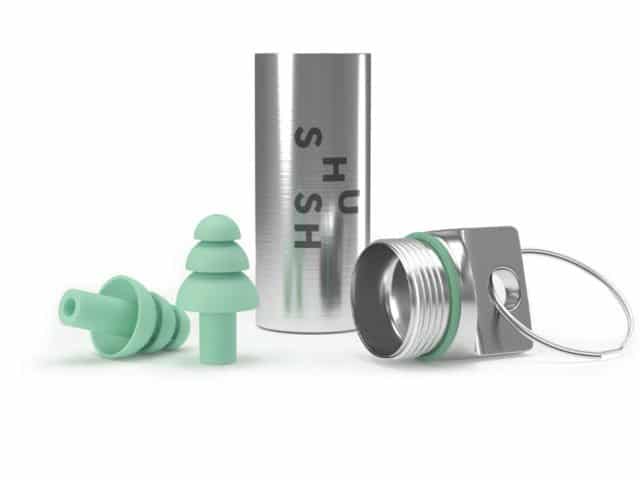
Shush Worker sits at the top of this list because of a combination of technical and material advantages that, taken together, are not matched by other universal filtered earplugs in this category. Shush Worker is best suited for manufacturing and industrial workers who wear hearing protection regularly throughout a full shift, need to communicate clearly with colleagues without removing their earplugs, and want a durable reusable solution that does not generate the ongoing waste and cost of disposable alternatives
Ceramic filter technology
The most significant differentiator is the filter itself. Most universal filtered earplugs use simpler filter constructions, often ER-type mesh filters or plastic filter assemblies. The Shush Worker uses a ceramic filter. The ceramic material is fired at approximately 1,400 °C, producing an extremely hard and durable component that does not degrade the way less robust materials can over time. This hardness contributes to better sound transmission through the filter. The filter is also shaped using a Venturi shaped channel, designed to allow sound to pass through with less resistance. The result is a combination of genuine noise reduction, rated at SNR 23 dB, and a more natural sound quality than you get from filters that simply block indiscriminately.
Internal filter placement and three-flange fit
A second important construction difference is the position of the filter. With competing products, the filter is positioned at the tip of the stem, meaning it sits at the outermost point of the earplug. In the Shush Worker, the filter is positioned inside the earplug body. This internal placement allows the earplug to use three flanges rather than requiring separate eartip sizes. The Shush Worker functions as a three-in-one fit, accommodating a wide range of ear canal sizes without needing interchangeable tips. There are no loose eartips to swap out and no separate replaceable filters. The earplug is a single integrated unit. This means there are no small components to lose and no risk of parts becoming detached during use. Some competing products that use interchangeable tips do offer the advantage of choosing between multiple sizes for a more tailored fit, which is worth acknowledging. But for most users, the three-flange design of the Shush Worker provides a reliable, secure fit without that complexity.
Medical-grade synthetic rubber construction
The earplug body itself is made from medical-grade synthetic rubber, not standard silicone. This is a meaningful distinction. According to Shush’s product specifications, the synthetic rubber is denser and thicker than most silicone alternatives, which contributes to higher passive noise attenuation alongside the ceramic filter. The material is also significantly more durable, lasting four times longer than standard silicone earplugs. Standard silicone can be affected over time by heat and the substances present in the ear canal, including earwax components. The synthetic rubber used in the Shush Worker is designed to resist these factors and maintain its performance over an extended product life. The materials are of medical quality and have been developed to minimise the risk of skin irritation or allergic reactions, making them a practical choice for workers who have experienced reactions to standard foam or silicone plug materials.
2. Pluggerz UniFit – dual size with a cord
Pluggerz earplugs are using a flanged silicone body with a built-in acoustic filter. The Uni-Fit model comes in two sizes. The filter provides a degree of frequency-balanced attenuation, making speech more intelligible than foam alternatives. At this price point, the silicone body is less durable than higher-specification materials, and the filter technology is simpler than the ceramic construction used in the Shush Worker. A reasonable entry-level option for workers who want to move away from disposable foam without a significant upfront cost, but not the strongest performer in this category on durability or sound quality.
3. Alpine WorkSafe – budget-friendly alternative
The earplugs are made from a soft thermoplastic body with a plastic filter at the stem. The thermoplastic body is less dense than medical-grade synthetic rubber, which affects both durability and attenuation. Alpine claims an SNR of 23 dB, but that is without the standard deviation. For the price Alpine is a good option if you are using earplugs incidentally when using tools, but not for a whole day in an industrial noise environment. If you need earplugs only once in a while Alpine is a good option.
4. Eargasm High Fidelity Earplugs – dual-size kit with carrying case
Eargasm positions its High Fidelity earplugs around a flat attenuation curve and includes two earplug sizes in the kit, which addresses the fit variability that comes with universal designs. The soft silicone body is comfortable for many users, and the carrying case makes them practical for daily use. The filter is an ER-type acoustic filter, which performs well for frequency balance but does not offer the material durability or construction specificity of a ceramic filter. The two-size approach is a practical advantage for users who find that standard universal designs do not fit well. For industrial environments specifically, the attenuation level and material durability are lower than the Shush Worker provides.
5. Etymotic ER20 – Less comfort, less attenuation
The Etymotic ER20 is one of the oldest earplugs in this category. Using a triple-flange design and ER-type filter. Their filter is used by many other brands. Of course the Etymotic falls short relative to the innovative new Shush Worker, not only in filter technology, but also in body material durability, and the passive attenuation contribution of the earplug body itself. The construction and materials do not match the Shush Worker at the technical level. But also in comparison to the other brands the Etymotic earplugs are quite expensive. So it’s not a cheap alternative as you would expect.
Choosing the right earplug for your work environment
The right hearing protection for factory work depends on how often you wear it, how long your shifts are, and what you need to be able to do while wearing it. No single product is the right answer for every situation, and it is worth being honest about that rather than overstating any one option.
If you only need hearing protection occasionally — for a one-off task or an infrequent situation — disposable foam earplugs from 3M or Howard Leight are a practical, low-cost choice. They do the job for that purpose. If you need protection for the majority of every working day and your employer can support the investment, custom-moulded earplugs are genuinely the most comfortable and precisely fitted solution for that level of use.
For the large middle ground — workers who need reliable daily hearing protection, want a reusable solution, and need to communicate clearly on the floor — universal filtered earplugs are the most practical category. Within that category, the Shush Worker earplugs stand out on the specific points that matter most for industrial use: ceramic filter technology fired at 1,400 °C for long-term durability, a Venturi-shaped filter profile for more natural sound transmission, internal filter placement that enables a three-flange universal fit without loose components, and a medical-grade synthetic rubber body that is denser, more durable, and longer-lasting than standard silicone. The combination of those features — not any single one in isolation — is what makes the Shush Worker the strongest option in this category for factory and manufacturing workers. Whatever you choose, wearing your protection consistently throughout every shift matters more than having the technically optimal earplug sitting unused in your pocket.
Frequently Asked Questions
How do I know if my current earplugs are actually providing enough protection for my specific work environment?
The best starting point is checking the measured noise level in your work area — your employer is legally required to conduct noise assessments under OSHA regulations if levels are at or above 85 dB. Once you know the decibel level, compare it against the NRR (Noise Reduction Rating) of your earplug: a rough real-world estimate is to subtract 7 from the NRR and divide by 2 to get the effective noise reduction in practice. If you don’t have access to formal measurements, a free sound level meter app on your smartphone can give you a rough baseline to work from.
What's the right way to insert foam earplugs to actually get the full NRR protection?
Most workers don’t get the full rated protection from foam earplugs simply because of improper insertion. The correct technique is to roll the foam into the tightest possible cylinder with clean, dry hands, then reach over your head with the opposite hand to gently pull your ear upward and outward to straighten the ear canal, insert the compressed plug, and hold it in place for 20–30 seconds while it expands. If you can still hear significant ambient noise immediately after insertion, pull the plug out and repeat the process — a proper seal should noticeably muffle your surroundings right away.
Can I wear earplugs all day, every day without causing any problems with my ears?
Consistent daily use of properly fitting earplugs is generally safe and strongly recommended in high-noise environments, but a few hygiene practices matter. Disposable foam plugs should never be reused since they trap moisture and bacteria against the ear canal, and reusable plugs should be cleaned regularly according to the manufacturer’s instructions. If you notice itching, soreness, or discharge in your ear canal, stop use and consult a doctor — these can be signs of an allergic reaction to the plug material or an ear canal infection, both of which are manageable if caught early.
Are reusable earplugs like the Shush Worker or Etymotic ER20XS actually more cost-effective than disposable foam in the long run?
Yes, significantly so when you do the math. A quality pair of disposable foam earplugs costs roughly $0.20–$0.50 per pair, which adds up to $50–$130 per worker annually if replaced daily. A durable reusable option like the Shush Worker, used and cleaned properly, can last months or longer, bringing the cost-per-use down to a fraction of that figure. Beyond cost, reusable plugs also generate far less material waste, which matters for companies with sustainability or waste-reduction commitments.
My workplace requires dual hearing protection in certain zones — can I wear earplugs under earmuffs, and does it actually help?
Yes, combining earplugs with earmuffs — known as dual protection — is a recognized OSHA-compliant approach for environments exceeding 100 dB, such as heavy stamping operations or areas near jet engines. When used together, the combined protection is not simply the sum of both NRR ratings; in practice, you typically add about 5 dB of additional protection on top of the higher-rated device. Make sure the earplugs are fully and correctly inserted before placing the earmuffs over them, as a poor earplug seal undermines the benefit of the combination.
What should I do if I consistently find earplugs uncomfortable and end up removing them during my shift?
Discomfort is the single biggest reason hearing protection fails in practice, and it’s worth troubleshooting rather than just pushing through. First, try a different foam density or plug style — softer options like the Moldex Pura-Fit are specifically designed for workers who find standard foam painful over long shifts. If foam plugs are the issue, switching to a flanged reusable design or a high-fidelity plug like the Shush Worker eliminates the compression pressure entirely. If discomfort persists across multiple plug types, it’s worth seeing a doctor to rule out an unusually narrow or sensitive ear canal, which may require a custom-molded solution.
How do I convince my employer to upgrade from cheap disposable foam to better hearing protection options for the whole team?
Frame the conversation around compliance risk and total cost rather than product preference. OSHA’s Hearing Conservation Amendment (29 CFR 1910.95) requires employers to provide adequate hearing protection and conduct annual audiometric testing for exposed workers — hearing loss claims and workers’ compensation costs from noise-induced hearing damage are a measurable financial liability. You can also present the cost-per-use comparison showing that reusable options often reduce annual spend per worker, and point to the practical benefit of workers actually keeping their protection in because it’s comfortable and doesn’t block communication.
Related Articles
- How do you ensure hearing protection compliance on a job site?
- Does occupational noise cause fatigue?
- Can better earplugs improve hearing protection compliance?
- What is noise-induced hearing loss and can concerts cause it?
- How do filters in high-fidelity earplugs preserve sound quality?
- Should teenagers wear ear protection when going to nightclubs?
- Do I need earplugs for my first EDM event?
- What decibel reduction do you really need for music sound protection?
- What should you look for when buying earplugs for music sound protection in 2026?
- What is the difference between earplugs for live music and standard foam plugs?
- How do you find earplugs that fit securely at a crowded EDM event?
- Can concert earplugs help with sensory overload at live events?
- Do earplugs affect your ability to communicate with people at loud events?
- How does standing near speakers at a stadium concert affect hearing damage risk?
- What is the safest way to protect your hearing at outdoor stadium concerts?